What Is CFOP? The Method Speedcubers Use
CFOP is the most popular speedsolving method for the Rubik's Cube, breaking the solve into four stages: Cross, F2L, OLL, and PLL. Here's how it works.
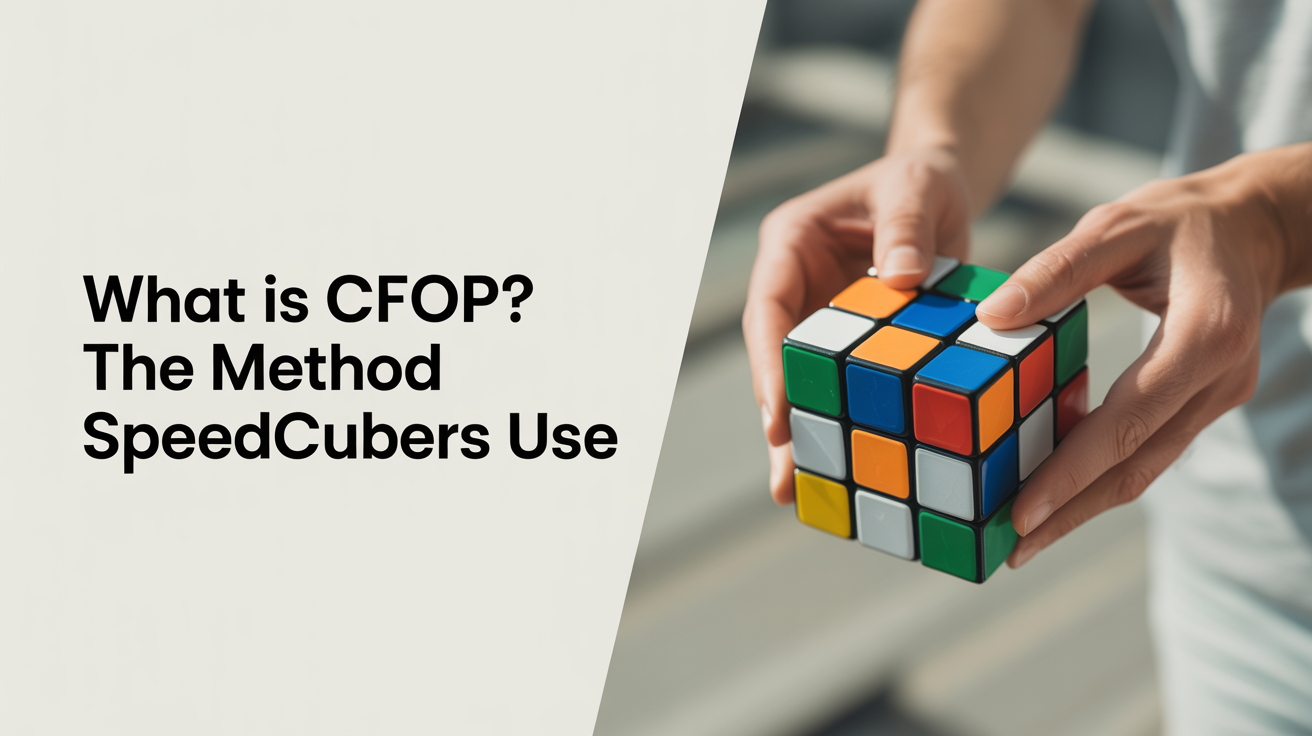
If you've watched a speedcuber blast through a solve in under 10 seconds and wondered what on earth they were doing, the answer is almost certainly CFOP. It's the method used by the overwhelming majority of top competitors, and it's the natural next step once you've outgrown the beginner layer-by-layer approach. Getting to grips with what CFOP actually is, before committing to learning it, is the smartest thing you can do.
At a Glance
- CFOP stands for Cross, F2L, OLL, PLL, the four stages every solve moves through in order.
- It's also called the Fridrich method, after Jessica Fridrich, the academic and speedcuber who documented and popularized it in the 1990s.
- CFOP solves in roughly 55 moves on average, well under the 100-plus moves a beginner method typically takes.
- The full algorithm set is 78 algorithms (57 OLL plus 21 PLL) plus roughly 41 F2L cases, but a working version needs only about 16.
- Most learners move through it in a fixed order: solid beginner method first, then intuitive F2L, then 2-look OLL, then 2-look PLL.
- CFOP is the dominant method at official competitions, though alternatives like Roux and ZZ have loyal followings.
What CFOP Stands For
CFOP is an acronym for the four stages of the solve:
- C: Cross
- F: F2L (First Two Layers)
- O: OLL (Orient Last Layer)
- P: PLL (Permute Last Layer)
Each letter is a distinct phase. You finish one completely before moving on to the next. That structure makes the method both learnable and extremely scalable. Beginners can work through each stage separately, while advanced solvers refine every phase over months or years of practice.
CFOP is also called the Fridrich method, after Jessica Fridrich, a Czech-American academic who documented and popularized it in the 1990s. According to her Wikipedia biography, she first picked up a cube in 1981 at age 16, won the Czech national championship the following year, and went on to become an electrical engineering professor. She didn't invent every piece of the method. Various cubers contributed different elements over the years, but she was the one who formalized the system and published it online in 1997, and her name stuck. The CFOP method reference on Wikipedia credits her specifically with developing the OLL and PLL algorithm sets that made the last two stages fast and repeatable.
The Four Stages Explained
Cross
The solve starts by building a cross on one face. Most people learn to do this on the white face, and CFOP keeps that convention. The cross consists of four edge pieces, each correctly oriented and matched to the center on the sides.
Sound familiar? The beginner method starts here too. The difference is speed and planning. Experienced CFOP solvers plan the entire cross during the inspection period (the 15 seconds before the timer starts) and execute it in as few as four moves. Rather than solving one edge at a time in a fixed order, they find the most efficient sequence for all four edges at once.
A well-solved cross takes roughly four to eight moves. That efficiency sets up everything that follows.
F2L (First Two Layers)
F2L is where CFOP diverges most sharply from the beginner method. Instead of solving the middle layer as a separate step after the white cross, you solve the corners and edges of the first two layers at the same time, as pairs.
Here's the idea: each corner on the bottom layer has a matching edge in the middle layer. A white-green corner pairs with the white-green edge, for example. In F2L, you find that corner and its partner edge, join them into a pair somewhere in the top layer, and insert the pair into its slot together in a single fluid sequence.
There are 41 standard F2L cases, each with a recommended algorithm. But many solvers learn F2L intuitively first, experimenting until they understand how pairs work, and only look up specific algorithms later. That intuitive foundation is worth building before you memorize anything, since it means you can solve any pairing situation you encounter, even ones that don't map neatly onto a memorized case.
F2L is the biggest efficiency gain over the beginner method. What used to be two separate steps (corners, then middle edges) becomes one. Move counts drop noticeably as a result, typically by 20 to 30 moves across a full solve.
For a deeper look at how pairs work in practice, see What Is F2L?.
OLL (Orient Last Layer)
After F2L, you have a complete cube except for the top layer. OLL fixes the orientation of every piece on that layer. Its goal is a solid-color top face, with every sticker pointing upward. Positions don't need to be correct yet, just oriented.
Full OLL has 57 algorithms, one for each possible orientation pattern. Learning all 57 is a significant project and not something most beginners tackle immediately. The practical entry point is 2-look OLL, which breaks orientation into two smaller steps:
- Orient the top-layer edges (4 algorithms)
- Orient the top-layer corners (about 7 algorithms)
That's roughly 10 algorithms total, which is manageable for someone who has just come from the beginner method. The trade-off is that 2-look OLL takes two steps instead of one, adding a few moves to your solve. As you improve, you gradually replace 2-look recognition with full OLL recognition, case by case.
PLL (Permute Last Layer)
The final stage. Every piece on the top layer is now oriented correctly, and PLL moves them to the right positions. A solved cube is one complete PLL algorithm away.
Full PLL has 21 algorithms. Two-look PLL, the beginner-friendly version, splits permutation into:
- Permute the corners (2 algorithms)
- Permute the edges (about 4 algorithms)
Six algorithms in total is a realistic starting target. Once those are solid, you can learn the full 21 over time and shave moves off your last layer.
For a detailed breakdown of both OLL and PLL, including which algorithms to learn first, check out OLL and PLL Explained for Beginners.
CFOP's Algorithm Load, Stage by Stage
It helps to see the full weight of CFOP broken down by stage rather than as one intimidating total. Here's what each phase actually requires, from the "just get it done" version to the competitive version:
| Stage | Intuitive / minimum | Full algorithm set | Notes |
|---|---|---|---|
| Cross | 0 (planned, not memorized) | 0 | Always intuitive, even for top solvers |
| F2L | 0 (paired intuitively) | 41 | Most solvers learn this by understanding, not memorizing |
| OLL | ~10 (2-look) | 57 | Biggest single jump in algorithm count |
| PLL | ~6 (2-look) | 21 | Smallest full set, often finished first |
| Total | ~16 | ~119 (41 F2L + 57 OLL + 21 PLL) | Full set is a long-term goal, not a starting point |
CFOP vs. the Beginner Method: Why It's Faster
The beginner method solves the cube in roughly seven steps and often takes more than 100 moves. CFOP collapses those into four stages and targets around 55 moves for an efficient solve. That gap explains most of the time difference.
Here's a side-by-side comparison:
| Step | Beginner Method | CFOP |
|---|---|---|
| Bottom cross | Cross | Cross (planned in inspection) |
| Bottom corners | Separate step | Combined into F2L |
| Middle layer | Separate step | Combined into F2L |
| Top orientation | Two steps | OLL (or 2-look OLL) |
| Top permutation | Two steps | PLL (or 2-look PLL) |
| Typical move count | 100+ | ~55 |
| Algorithms to learn | ~5 | ~10 (2-look) to 78 (full) |
The compression is substantial. F2L alone eliminates two full beginner steps. The last layer in CFOP is more algorithmic but also more predictable. Once you recognize a pattern, you know exactly what to do.
Should You Learn CFOP Now?
CFOP rewards people who already have a comfortable handle on the beginner method. If you can solve the cube reliably without help, you're ready to start exploring it.
The realistic learning order looks like this:
- Get consistent with the beginner method (don't worry about speed)
- Learn intuitive F2L with no memorized algorithms, just pairing logic
- Learn 2-look OLL (about 10 algorithms)
- Learn 2-look PLL (about 6 algorithms)
- Practice until you're solving consistently under two minutes, then push toward sub-90
- Start filling in full OLL and PLL as motivation builds
Most people see meaningful time improvements after each stage. Don't wait until you've memorized everything before starting to apply what you know.
If you're weighing exactly when to make the transition, Beginner Method vs CFOP: When to Make the Switch walks through the decision in detail.
How Many Algorithms Does CFOP Actually Require?
This question stops a lot of people before they start. The full algorithm count for CFOP is 78 last-layer algorithms (57 OLL plus 21 PLL), plus around 41 F2L cases if you eventually memorize those too. That sounds like a lot. But almost nobody learns them all at once, and nobody needs to.
The minimum viable version of CFOP is intuitive F2L plus 2-look OLL plus 2-look PLL. That version requires around 16 algorithms total. It's enough to solve the cube using the CFOP framework and get times well under a minute. From there, you add algorithms gradually as they naturally come up in solves.
Think of the full algorithm set as a long-term goal, not an entry requirement. The speedsolving.com wiki entry on CFOP is a useful reference once you're ready to branch out into full OLL and PLL, since it documents multiple algorithm variants for the trickier cases side by side.
FAQ
Is CFOP the only speedsolving method?
No. Other methods exist, including Roux, ZZ, and Petrus. Each has its own logic and community of practitioners. CFOP is by far the most widely used, partly because of the resources available and partly because the beginner method is already a partial foundation for it. That said, the best method is the one you'll stick with and enjoy practicing.
How fast can you get with just 2-look OLL and PLL?
Most people reach somewhere in the 30 to 50 second range with 2-look CFOP and solid F2L. Breaking into the sub-20 range typically requires full OLL and PLL along with faster look-ahead during F2L. Two-look is a genuine speedsolving tool, not just a stepping stone.
Is Jessica Fridrich the inventor of CFOP?
She documented and popularized it, but the method has multiple contributors. F2L-style thinking, OLL, and PLL developed somewhat independently across the early cubing community between the late 1970s and early 1990s. Fridrich published a comprehensive write-up that became the go-to reference, which is why her name is attached to the method.
Can I learn CFOP from the beginner method without starting over?
Yes. The cross is identical. F2L replaces two beginner steps but builds on the same corner-and-edge logic. You don't discard what you already know; you extend it. Most people find the transition smoother than expected once they understand what F2L is actually doing.
Do I need a special cube to learn CFOP?
Any cube that turns smoothly enough not to frustrate you will work. Budget speed cubes are widely available and perform well. The more important investment is time on the cube, not gear. Once you're solving consistently, a better cube can help, but it's never the limiting factor for a beginner.
Why do so many top competitors still use CFOP instead of a newer method?
Partly momentum and resources: decades of documented algorithms, tutorials, and coaching make CFOP the path of least resistance for anyone chasing competitive times. It also genuinely performs well, since F2L's pairing efficiency and the two-look-to-full-algorithm pipeline scale smoothly from beginner to world-class. Newer methods like Roux can match or beat CFOP's move count for some solvers, but the learning ecosystem around CFOP is hard to match.