Double Turns and Wide Moves in Cube Notation
Learn what R2, U2, and wide moves mean in cube notation, including the 2 suffix, Rw moves, lowercase letters, and slice moves M, E, and S.
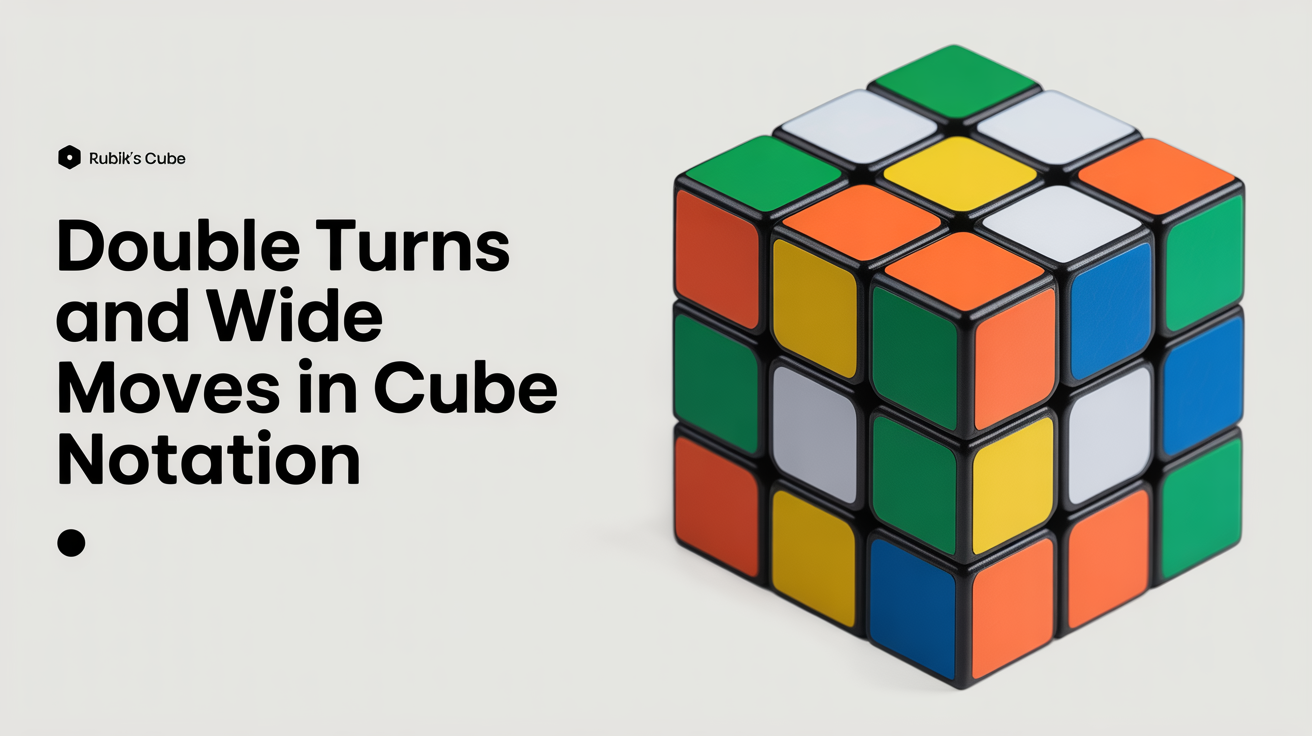
If you have started reading cube algorithms, you have probably run across moves like R2, Rw, or M and wondered what they mean. The basic face moves, R, U, L, D, F, B, are covered in cube notation basics, but those letters only scratch the surface. Once you add the 2 suffix, wide moves, and slice moves, you can read the vast majority of algorithms you will encounter as a beginner.
This guide explains each of those additions one at a time.
What the 2 Suffix Means
In standard cube notation, a plain letter like R means one quarter-turn (90 degrees) of the right face in the clockwise direction. Adding a prime symbol reverses that direction, the prime symbol and what it does is worth reading if that part is unfamiliar.
The 2 suffix means something different: turn that face 180 degrees, or two quarter-turns in a row.
R2, turn the right face 180 degreesU2, turn the top face 180 degreesL2, turn the left face 180 degreesD2, turn the bottom face 180 degreesF2, turn the front face 180 degreesB2, turn the back face 180 degrees
Because a 180-degree turn lands in the same position whether you go clockwise or counterclockwise, direction does not matter for 2 moves. R2 and R2' are the same outcome, so you will almost never see the prime combined with the 2.
A practical way to think about it: R2 swaps the top-right and bottom-right corners of the right face with each other, and it swaps the two edge pieces in between. Everything on the right face ends up directly across from where it started.
R2 Meaning in Practice
When you see R2 U2 R' U2 R2 in an algorithm, you read it left to right and execute each move in order. The R2 at the start is simply a single 180-degree turn of the right face, do it in one smooth motion, not two separate quarter-turns.
Many beginners get this right instinctively, but it is worth saying: you are not doing R twice with a pause in between. Treat R2 as its own move. With a bit of practice it becomes automatic.
Wide Moves and What Lowercase Letters Mean
A standard face move only turns the outer layer of the cube. Wide moves turn two layers at once, the outer layer plus the layer directly behind it.
There are two common ways to write a wide move:
- Lowercase letter,
r,u,l,d,f,b - Capital letter with "w",
Rw,Uw,Lw,Dw,Fw,Bw
Both mean the same thing. r and Rw both tell you to turn the right face AND the slice of the cube directly behind it, together, as one unit.
Wide moves with the 2 suffix work exactly as you would expect:
Rw2orr2, two-layer wide turn of the right side, 180 degreesUw2oru2, two-layer wide turn of the top, 180 degrees
You will run into wide moves more often as you progress past the beginner method, but knowing the notation now means algorithms never catch you off guard.
Slice Moves: M, E, and S
Slice moves turn only the middle layer of the cube, the layer sandwiched between two outer faces. There are three of them.
| Move | Layer | Positive direction |
|---|---|---|
M | Middle (between L and R) | Same direction as L (left face) |
E | Equator (between U and D) | Same direction as D (bottom face) |
S | Standing (between F and B) | Same direction as F (front face) |
The direction conventions trip people up at first. M follows the left face, not the right, so M and L both move their respective layers the same way. If you already know which way L goes, M goes the same way.
Slice moves also take the ' prime and 2 suffixes:
M', middle slice in the direction ofRM2, middle slice 180 degreesE2, equator slice 180 degrees
You will see M moves often in algorithms that set up or fix specific edge pieces, particularly in finger trick sequences and certain last-layer cases. For now, reading them correctly is enough, execution comes with practice.
Quick Reference Table
| Notation | Meaning |
|---|---|
R2 | Right face 180 degrees |
U2 | Top face 180 degrees |
r or Rw | Right face + layer behind it (two layers) |
r2 or Rw2 | Wide right move, 180 degrees |
M | Middle slice, L direction |
M' | Middle slice, R direction |
M2 | Middle slice, 180 degrees |
E | Equator slice, D direction |
S | Standing slice, F direction |
For a broader look at how all these pieces fit together into a complete algorithm, how to read a Rubik's Cube algorithm walks through the process step by step.
Frequently Asked Questions
Is R2 the same as doing R and then R again?
In effect, yes, two clockwise quarter-turns land in the same place as one 180-degree turn. In practice, experienced solvers treat R2 as a single fluid motion rather than two separate moves. The notation signals the destination, not the number of hand movements you make.
Does direction matter for double turns?
No. Since you are rotating 180 degrees, clockwise and counterclockwise arrive at the same position. That is why you will rarely see R2' written in an algorithm, it would be redundant. The 2 by itself is enough.
What is the difference between r and Rw?
Nothing. They are two different ways of writing the same move. Older algorithm databases often use the capital-letter-plus-w format (Rw), while more recent resources and some software use the lowercase format (r). Learn to recognize both and you will be able to read algorithms from any source.
When will I actually use wide moves?
Wide moves appear regularly in intermediate and advanced methods, especially for solving the last layer quickly. In the basic beginner method, you may not need them at all, but you will start seeing them in guides the moment you look at methods like CFOP. Knowing what the notation means now saves confusion later.
Are slice moves the same as wide moves?
Not exactly. A wide move (r, Rw) turns two layers that include an outer face. A slice move (M, E, S) turns only the middle layer and does not include any outer face. The practical difference: a wide move and its corresponding slice move can combine to produce the same effect as a single outer face move, but they are distinct moves in algorithms.