Rubik's Cube Notation Explained (R, U, L, D, F, B)
Learn what R, U, L, D, F, and B mean in Rubik's Cube notation — plus primes, doubles, wide moves, and how to read any algorithm as a beginner.
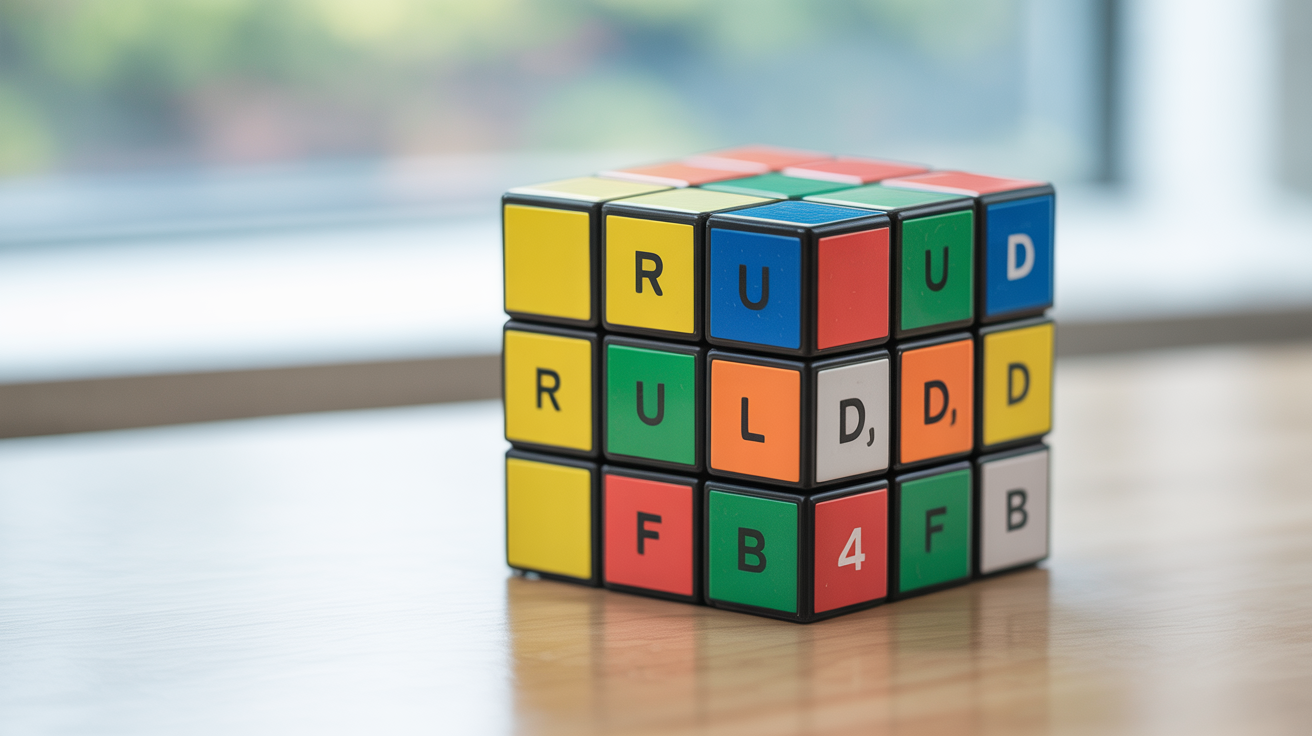
Every time you look up a solving method, you run into strings of letters like R U R' U' or F R U R' U' F'. They look like code, and for a beginner they might as well be. But cube notation is genuinely simple once you understand the one rule that everything else grows out of: each letter names a face, and the move turns that face clockwise as seen from outside the cube.
That's it. Six faces, six letters, and a small handful of modifiers to handle counter-clockwise, 180-degree, and multi-layer turns. Give yourself ten minutes with this guide and you'll be able to read any beginner algorithm without stopping to decode it.
The Six Face Letters and What They Mean
Hold your cube so one face points toward you. You now have six faces, each with a name:
| Letter | Face | Direction of turn |
|---|---|---|
| R | Right face | Clockwise when looking directly at the right side |
| L | Left face | Clockwise when looking directly at the left side |
| U | Up (top) face | Clockwise when looking down at the top |
| D | Down (bottom) face | Clockwise when looking up at the bottom |
| F | Front face | Clockwise when looking at the face closest to you |
| B | Back face | Clockwise when looking at the face farthest from you |
Write this table on a sticky note and keep it next to you the first few times you work through an algorithm. After a few sessions it will be automatic.
The One Rule That Clears Up All Confusion
The phrase "clockwise as if you are looking directly at that face" is worth repeating because it trips people up on L and D every single time.
Stand in front of your cube. An R move rotates the right layer, the top cubie on that face moves toward you. Makes sense. Now try L. A clockwise L, viewed from the left side of the cube, moves the top cubie on that face away from you. From your normal vantage point at the front, it looks like the left layer is going up on the back. That's not wrong, that's just what "clockwise from the left side" looks like when you're watching from a different angle.
Same story with D. Looking up at the bottom of the cube, clockwise sends the front edge of the bottom layer to the right. From above, that's the opposite of what U does.
The fix: whenever you perform L or D, tilt the cube briefly so you're actually looking at that face. Then clockwise is obvious. Over time you won't need to do this, but it's the clearest way to learn.
Modifiers: Primes, Doubles, and Wide Moves
The six base letters cover the basics, but three modifiers extend the system to handle every move you'll need as a beginner.
The Prime Symbol (')
A prime mark after a letter means counter-clockwise, viewed from the same outside perspective. So R' is the right face turning counter-clockwise when you're looking at the right side. Cubers read it aloud as "R prime", some say "R inverse" or "R anti."
You'll see primes constantly. The beginner trigger R U R' U' uses two: R' undoes the R, and U' undoes the U. Learning that primes undo their plain counterpart is useful mental shorthand.
For a deeper look at why the prime symbol behaves the way it does, see What Does the Prime Symbol Mean in Cube Notation.
The Double (2)
A 2 after a letter means a 180-degree turn, two quarter-turns in a row. R2 flips the right face halfway around. Because 180 degrees lands in the same place regardless of which direction you spin, R2 and R2' are identical moves; the prime is usually omitted.
Wide Moves
Lowercase letters or a w suffix indicate wide moves that pull two layers at once. r (or Rw) turns the right face and the middle layer next to it together. u turns the top two layers. You'll encounter these in intermediate and advanced methods, less so in pure beginner tutorials, but knowing they exist keeps you from being confused when you spot a lowercase letter in an algorithm.
Slice Moves and Cube Rotations
Two more categories appear in many guides. You don't need to master them immediately, but you should be able to recognize them.
Slice Moves
Slice moves turn a middle layer without moving either outer face.
| Letter | Layer moved | Follows the direction of |
|---|---|---|
| M | Middle (between L and R) | L (same direction as an L move) |
| E | Equator (between U and D) | D (same direction as a D move) |
| S | Standing (between F and B) | F (same direction as an F move) |
The M move is the one you'll meet earliest, it shows up in some 3x3 algorithms and is central to 2x2 and Megaminx solving.
Cube Rotations
Rotations spin the whole cube in your hands without changing any face relative to itself.
| Letter | Rotation axis | Equivalent face direction |
|---|---|---|
| x | Tilts the cube as R would | Follows R direction |
| y | Spins the cube as U would | Follows U direction |
| z | Rotates the cube as F would | Follows F direction |
Rotations are used in algorithms to reorient the cube mid-sequence so the next moves land on the right face. Like slice moves, primes and doubles apply: y' spins the whole cube in the U-prime direction, x2 flips it upside down.
How to Practice Reading Algorithms
Reading notation and executing it are separate skills that both need practice. Here's a method that works well for beginners.
Start with a very short algorithm, four or five moves. Write out what each letter means before you touch the cube. For R U R' U', that would be: right clockwise, top clockwise, right counter-clockwise, top counter-clockwise. Only after you've translated it mentally should you perform it.
Then go back to the starting state and do the algorithm from the notation alone, no translation. Repeat until it flows. You'll notice your hands start to recognize move pairs before your brain consciously processes them. That muscle memory is what experienced solvers call "knowing an algorithm", not memorizing a string of letters, but having a physical pattern wired in.
For a broader look at putting multiple moves together, How to Read a Rubik's Cube Algorithm walks through parsing full solving algorithms step by step.
One more thing worth understanding early: the center cubie on each face never moves relative to the others. The red center is always the red face, no matter what moves you make. That's why notation works, the face letters always refer to fixed positions, not fixed colors. Read more about why this matters in Why the Centers Never Move and Why It Matters.
A Quick Reference Table for All Standard Moves
| Notation | Move type | Description |
|---|---|---|
R | Face | Right face, 90° clockwise |
R' | Face | Right face, 90° counter-clockwise |
R2 | Face | Right face, 180° |
L | Face | Left face, 90° clockwise (from left) |
L' | Face | Left face, 90° counter-clockwise (from left) |
U | Face | Top face, 90° clockwise (from above) |
U' | Face | Top face, 90° counter-clockwise (from above) |
D | Face | Bottom face, 90° clockwise (from below) |
D' | Face | Bottom face, 90° counter-clockwise (from below) |
F | Face | Front face, 90° clockwise |
F' | Face | Front face, 90° counter-clockwise |
B | Face | Back face, 90° clockwise (from behind) |
B' | Face | Back face, 90° counter-clockwise (from behind) |
M | Slice | Middle layer, follows L direction |
E | Slice | Equator layer, follows D direction |
S | Slice | Standing layer, follows F direction |
r / Rw | Wide | Right face + adjacent middle layer |
x | Rotation | Whole cube, follows R direction |
y | Rotation | Whole cube, follows U direction |
z | Rotation | Whole cube, follows F direction |
Keep in mind that every move in this table also accepts a prime or a 2 suffix. M2 is a very common move in certain algorithms; y' is used all the time when a method asks you to spin the cube to face a new color.
FAQ
Do I need to memorize all of this before I start solving?
No. You only need R, U, F, L, D, B and the prime modifier to follow most beginner tutorials. The rest of the system, slice moves, rotations, wide moves, can be picked up as you encounter them. Start with the six faces and primes, get comfortable, then expand.
Why do some algorithms use x, y, or z at the start?
Those are cube rotations that reorient the whole puzzle so the algorithm's face moves land correctly. Some tutorials include them to make the finger-work more natural; others just tell you to "hold the cube with white on top" and skip the rotation entirely. Either approach is fine.
Is R2 the same as doing R twice?
Yes, exactly. R2 is two consecutive clockwise quarter-turns, which adds up to one 180-degree flip. Some people write it as RR in shorthand, but R2 is the standard.
What's the difference between r and R?
Uppercase R turns only the right face. Lowercase r (also written Rw) turns the right face plus the middle layer right next to it, two layers moving together. You'll see wide moves in methods like CFOP when solvers skip a separate slice move by combining it with a face move.
I keep mixing up L and R when I'm following an algorithm. Any tips?
Two things help. First, hold the cube consistently, same color on top and facing you every time you start a new session. Second, try writing L and R on two small pieces of tape and stick them to the appropriate sides of your cube while you're learning. It sounds silly but it works quickly. Within a few hours of practice you won't need the tape anymore.