How to Learn Finger Tricks for Faster Turning
Learn how to turn the cube faster with finger tricks. A beginner-friendly guide to the moves that cut seconds off your solve time.
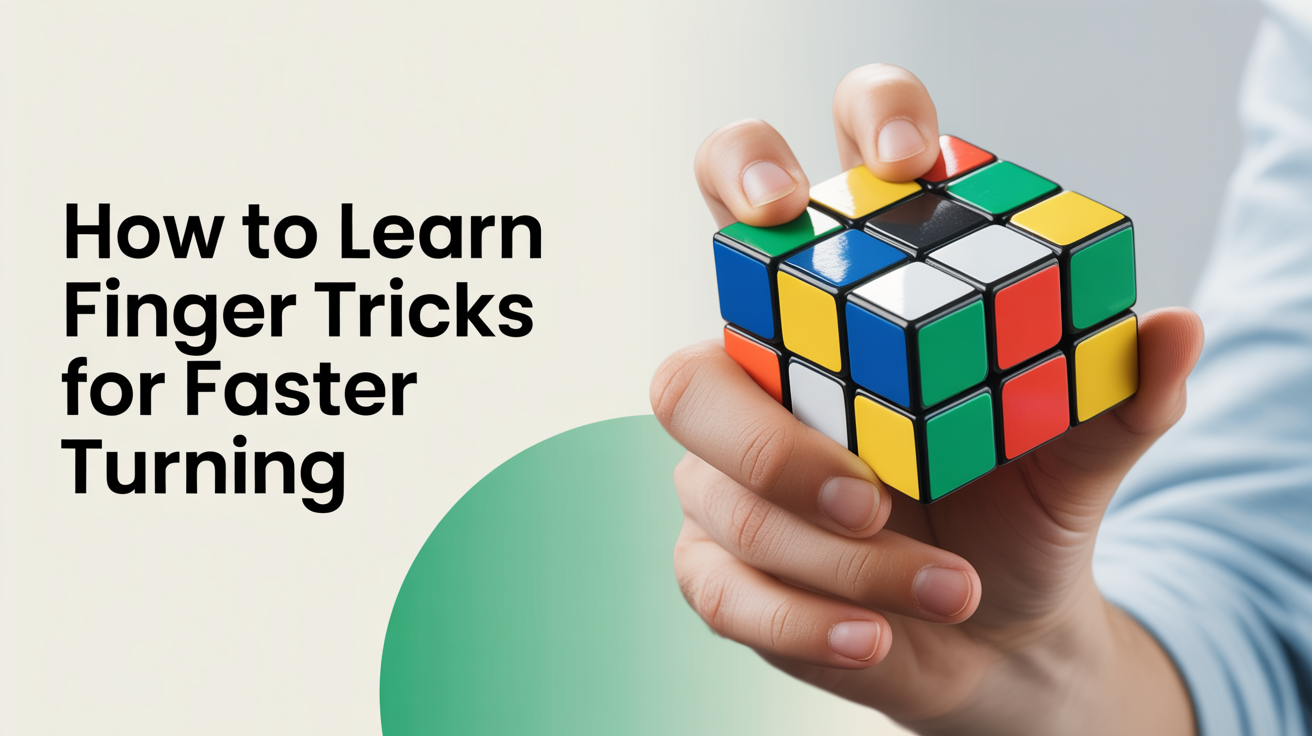
When you first learned to solve the cube, you probably held it in both hands and turned one face at a time, pausing to re-grip before the next move. That works fine for learning, but it is slow. The gap between a beginner and an intermediate solver often has less to do with knowing more algorithms and more to do with how the cube is moved. Finger tricks are the physical skill that lets you execute turns quickly and smoothly without stopping to reposition your hands. This guide explains what they are, which ones to learn first, and how to practice them.
What Are Finger Tricks?
A finger trick is any technique that lets you execute a cube move using a single finger motion rather than a full hand rotation. Instead of twisting your entire wrist to turn a face, you push or flick with one finger while the rest of the hand keeps the cube steady. The result is a much faster, lower-effort turn.
The goal is to keep the cube stable in your hands for as long as possible. Every time you stop to re-grip, you lose a fraction of a second. Over a sixty-move solve, those fractions add up. Finger tricks reduce grip changes and let moves flow into each other.
A quick note on notation before going further: in this guide, face names like R, U, F, L, D, and B refer to Right, Up, Front, Left, Down, and Back. A move without an apostrophe is a clockwise quarter turn; an apostrophe (like R') means counterclockwise. If any of those terms are new to you, it helps to read up on cube notation and the beginner method before diving into finger tricks.
The Most Important Trick: The Right-Hand Flick
The single most useful finger trick for beginners is the right-hand R move.
Instead of wrapping your hand around the cube and turning the right layer with your palm, use your index finger alone. Rest your index finger on the top-right edge of the R layer and push down and forward. The layer rotates ninety degrees. That is an R move done with one finger.
For R' (counterclockwise), most solvers use either the middle finger pulling upward from the bottom-right edge, or the index finger pushing backward along the top.
This trick matters most because R and U moves are the backbone of most beginner algorithms. Once you can flick R with one finger, you can start chaining R U R' U' sequences without putting the cube down.
To practice:
- Hold the cube in your normal solving grip.
- Execute ten
Rmoves in a row using only your index finger. - Then ten
R'moves. - Now alternate:
R U R' U', over and over, as slowly as needed to keep it clean.
Comfort before speed. Sloppy fast turns will misalign layers and slow you down more than careful slow ones.
Left-Hand Moves and Mirroring
Many algorithms mirror what the right hand does. L, L', and related moves should be handled by the left hand so your right hand can stay near the R layer.
The left-hand L' move is the mirror of the right-hand R flick: use your left index finger to push the left layer forward (away from you). L goes the other direction, typically pulled with the middle finger.
Beginners often neglect the left hand because most algorithms favor R U R' U' shapes. If you ever move beyond the beginner layer-by-layer method into CFOP, left-hand fluency becomes important for handling F2L cases efficiently.
Build the left hand at the same time as the right. Even if you only practice L' U' L U for five minutes a day, the movement becomes automatic quickly.
The U-Move Trigger
The U (top layer) move is the other half of most beginner algorithm sequences. It should flow immediately after an R or L trick without any re-gripping.
The standard technique: keep your right thumb on the front-right corner of the top layer and push left (toward the L side) to turn U clockwise. Your index finger may help guide the motion.
For U', the left thumb pushes the top layer to the right.
The key is coordination. After your index finger flicks R, your thumb should already be positioned to push U. Work on this transition specifically:
- Flick
Rwith your index finger. - Before the layer fully settles, start the
Umove with your thumb. - The two motions partially overlap.
This overlap is called trigger execution. The R U R' U' sequence, sometimes called the sexy move, is the most practiced trigger in speedcubing. Many solvers can do it in under a second once it becomes automatic. If you want to understand why this trigger appears in so many algorithms, the F2L system shows exactly how it slots pieces into place.
Common Sequences to Practice
Here are a few short sequences worth drilling as finger trick exercises. They appear often in beginner algorithms, so practicing them builds skill you can use immediately.
| Sequence | Common name | What to focus on |
|---|---|---|
R U R' U' | Sexy move | Right index flick, immediate U push |
R U R' | Partial trigger | Smooth R-to-U transition |
F R U R' U' F' | Sune setup | Front layer with left fingers, then standard trigger |
U R U' L' U R' U' L | Corner insert | Alternating right/left without re-gripping |
R' D' R D | Bottom trigger | Holding U face stable while turning D |
Do not try to learn all of these in one session. Pick the first two and repeat them until they feel natural. Add more as those become automatic.
Regripping Less Often
Even with good finger tricks, you will occasionally need to re-grip. The goal is to do it strategically, during pauses that are already built into a solve, rather than in the middle of a fast sequence.
Two habits help:
Lookahead gripping. When you finish an algorithm and need a moment to recognize the next case, use that moment to shift your grip if needed. You are pausing mentally anyway, so the physical adjustment costs almost nothing.
Predicting the next move. Before you begin a sequence, check what comes after it. If the next move is L', position your left hand in advance rather than adjusting mid-sequence.
Re-gripping is not a failure. At the beginner stage, one or two re-grips per solve is completely normal. The goal is to make each grip useful and to stop losing time to accidental stops.
How Long Does It Take?
Finger tricks feel awkward for the first week or two. The movements are small and precise, and your fingers are not yet conditioned to them. This is normal. The awkward phase passes faster than learning the algorithms did.
A rough timeline for most beginners:
- Days 1-3: Right-hand
Rflick feels unsteady, but you can do it. - Week 2:
R U R' U'runs somewhat smoothly. - Week 4: Trigger feels natural at medium speed; left-hand moves improving.
- Month 2: You notice your times dropping without learning any new algorithms.
The improvement in times during month two comes from turns being faster and re-grips decreasing, not from memorizing more moves. That is why finger tricks are worth practicing even before you decide to learn advanced methods.
Frequently Asked Questions
Do I need a special cube to use finger tricks? A well-lubed speed cube helps, but it is not required to start learning. The techniques work on any standard cube. That said, a smooth cube makes it easier to feel when a finger trick is working correctly because the layer glides rather than sticks. If your cube feels stiff, a drop of cube lubricant in the core can help.
Should I practice finger tricks without doing full solves?
Yes. Isolating specific sequences, like R U R' U' repeated fifty times, builds muscle memory faster than only practicing during full solves. Think of it like a musician running scales separate from playing songs. Both types of practice matter.
My cube keeps misaligning during fast turns. What am I doing wrong? Misalignment usually means you are turning too hard rather than too precisely. Fast turning is not forceful turning. A good finger trick uses a short, controlled motion. Slow down slightly, focus on the path of each turn, and let the cube's mechanism do the work. Speed comes after accuracy.
Is there a standard hand position I should use?
Most speedcubers hold the cube with their index fingers on the U layer sides, thumbs on the F layer, and middle/ring fingers supporting the bottom. This position gives both thumbs access to U moves and both index fingers access to R and L. Try it, but adjust based on what feels natural to you. Hand size and finger length vary; there is no single correct grip.
When should I start learning finger tricks? As soon as you can solve the cube consistently without looking up the algorithms. You do not need to be fast before starting. Learning the physical execution alongside the algorithms means you are building both skills at once, which is more efficient than treating them as separate stages.