Why the Centers Never Move (and Why It Matters)
Rubik's Cube centers are fixed to an internal core and never change position relative to each other. Learn why this fact is the foundation of every solve.
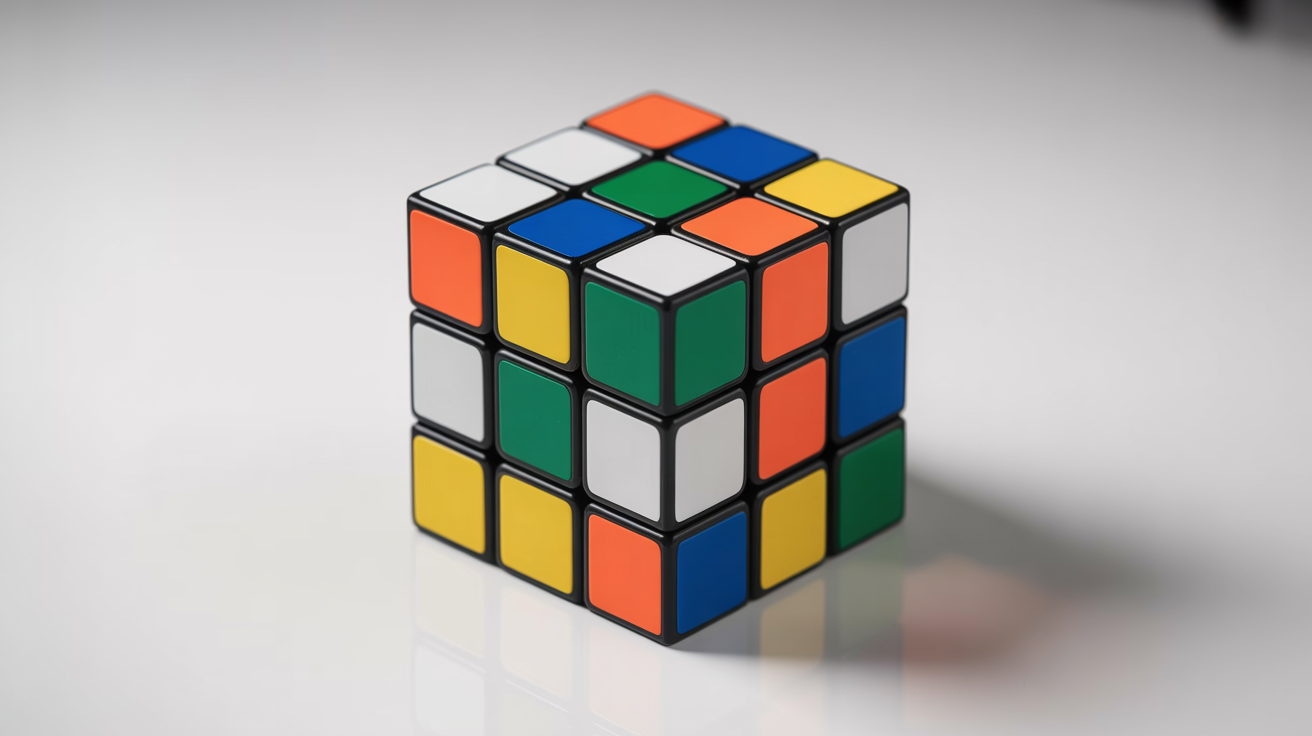
Pick up a scrambled cube and stare at it long enough, and one question usually surfaces: if everything is jumbled, how do you even know which color goes where? The answer comes down to the six center pieces and one property they have that no other piece shares. Once you understand what that property is, the whole puzzle starts making a lot more sense.
What Are the Center Pieces?
A standard 3x3 cube has 26 visible pieces. Eight of those are corners, twelve are edges, and six are centers. Each face has exactly one center, sitting in the middle of its 3x3 grid.
What makes centers different is what you can't see: they're attached to a rigid internal core, sometimes called a spindle or axle. The corners and edges are free to move around the outside. The centers are not. Turn any face and you'll see the edges and corners travel around the center. The center itself stays right where it started.
The Six Centers Are Always in the Same Arrangement
Because the centers are fixed to the core, their positions relative to one another are locked in forever. On any cube following the standard Western color scheme, you'll always find:
- White opposite yellow
- Blue opposite green
- Red opposite orange
No amount of scrambling changes that. Toss the cube across the room, run it through a hurricane of random turns, pick it up again: white is still facing away from yellow, and blue is still facing away from green. The centers define the cube's geometry, and nothing you do with your hands can rearrange them.
A center can rotate in place (spin around its own axis), but it cannot travel to a different face. That distinction matters, as we'll see in a moment.
Why the Centers Are Your Reference Points
Once you know that centers don't travel, a critical truth follows: each center permanently defines the color of its face.
The white center is on the white face. Full stop. You don't need to figure out where white is supposed to go — the cube tells you, every time, no matter the scramble.
This is the reason every beginner method starts with a cross. When a tutorial says "build the white cross," it means arranging four white edge pieces so they line up with the white center and also match the four side centers (red, blue, orange, green) they sit next to. You're not placing those edges relative to some abstract target; you're placing them relative to the centers, which are fixed anchors.
Without fixed centers, there would be no reference frame. You'd have 26 pieces and no way to know which arrangement counts as "solved."
You Solve Pieces to the Centers, Not the Other Way Around
This is subtle but worth sitting with. When you work on the cube, you move corners and edges into position. The centers never go anywhere; you move everything else toward them.
Think of the centers like the walls of a room. You rearrange the furniture to fit the room; you don't move the walls to accommodate the furniture. Keeping that mental model clear will save you a lot of confusion when you first start learning algorithms and notice the center never seems to do anything during a sequence.
What Happens When You Turn a Face
When you turn the right face 90 degrees, the four corners and four edges on that face rotate with it. The center of the right face does not move with them. It spins in place but stays on the right face.
This is easier to visualize if you imagine peeling the sticker off a center piece and replacing it with an arrow pointing upward. After a right-face turn:
- The edges and corners that were on that face have traveled to new positions on adjacent faces
- The center arrow still points upward, unmoved, because the center itself went nowhere
Now turn the top face. That brings corners and edges from the right face up to the top, but the top center stays on the top face and merely spins.
This chain of logic is why understanding cube notation matters so much early on. Every move letter (R, U, L, D, F, B) refers to a face identified by its center. R is the face whose center is on the right; U is the face whose center is on top. The center is the address, and the notation is how you describe moves relative to those addresses.
A Useful Way to Check Your Progress
Because each center is a permanent landmark, you can use them as a quick diagnostic at any point in a solve:
- If a corner or edge piece's colors don't match the surrounding centers, that piece is in the wrong place (or the wrong orientation).
- If every piece on a face matches the center, that face is done.
- If the pieces on a face match each other but not the center, you've accidentally arranged a pattern that looks solved but isn't. The center is the ground truth.
Beginners sometimes get confused when a face looks "almost done" but the center color is different from the pieces around it. That's an early sign the pieces traveled to the wrong location. The center, as always, is correct; the surrounding pieces need to move.
One Nuance: Picture Cubes and Center Orientation
On a standard solid-color cube, a center spinning in place doesn't matter. Whether the white center is rotated 45 degrees or 180 degrees, it still looks white. Nobody can tell.
Picture cubes, where each sticker carries a logo, image, or pattern, are a different story. Now the orientation of each center is visible. A rotated center means the picture is upside down on that face, even if every other piece is correctly placed. Solving picture cubes requires extra algorithms specifically to fix center orientation.
For the purposes of learning to solve a standard cube, center spin is irrelevant. All that matters is which face each center lives on, and that never changes.
Practical Takeaways for Beginners
Keep these points handy as you start learning:
- Don't look for where centers "should" go. They're already there, telling you exactly which color belongs on each face.
- Match everything to the centers. Cross edges, second-layer edges, corners — they all go into the spot defined by the surrounding centers.
- If a layer looks solved but the center color is wrong, the pieces moved to the wrong face. Re-check your recent turns.
- Algorithms are designed around centers. When you read an algorithm, every move letter refers to the face identified by its center piece.
- Center orientation only matters on picture cubes. On a solid-color cube, you can safely ignore it.
Understanding the notation that describes moves around centers, including the prime symbol that indicates reverse turns, will make learning algorithms much faster once you have the center concept locked in.
FAQ
Do the centers really never move on a Rubik's Cube?
Correct. On a standard 3x3 cube, the six center pieces never travel from one face to another. They're attached to an internal core, so each center can rotate around its own axis but stays on the same face no matter how many turns you make. Only edge and corner pieces change positions when you turn a face.
How do you know which color goes where if the cube is scrambled?
The centers tell you. Because each center is fixed to its face, it permanently identifies the color of that face. The white center is always on the white face; the red center is always on the red face. No scramble can change that, so you always have a reference point to solve toward.
What is the standard opposite-color arrangement on a Rubik's Cube?
On cubes that follow the standard Western color scheme, white is opposite yellow, blue is opposite green, and red is opposite orange. Because the centers never move, this arrangement is built into the cube's physical structure and never varies.
Does turning a face move the center of that face?
No. When you turn a face, the four corners and four edges on that face rotate around the center. The center itself stays put on the same face. Think of the center as the axis the other pieces rotate around, not as one of the pieces doing the rotating.
Why do picture cubes need extra steps to solve?
On a solid-color cube, a center that has spun in place still looks the same; it's just a solid color. On a picture cube, you can see if a center is rotated because the image will be tilted or upside down. Fixing those rotations requires additional algorithms that aren't needed for standard single-color cubes.