What Is an Average of 5 (Ao5)?
Learn what an average of 5 (Ao5) means in cubing, how it's calculated, why cubers use it, and how it differs from Ao12 and single solves.
If you have ever watched a cubing competition video and heard someone say "my Ao5 is 18 seconds," you might have wondered what that actually means. An Ao5, short for "average of 5", is the standard way competitive cubers measure consistent performance across a small set of solves. It is more meaningful than a single lucky solve, and once you understand how it works, you will start thinking about your own times differently.
What Exactly Is an Ao5?
An average of 5 is a score calculated from five consecutive solves using a specific formula: do five timed solves, throw out the fastest and the slowest, and then find the mean of the three that remain.
That trimming step is the key piece. By removing both extremes, an Ao5 filters out the flukes, the solve where a scramble handed you a two-look skip, or the one where you fumbled your fingers for ten seconds on an otherwise clean run. What is left is a number that reflects how you usually solve, not how you perform on your best or worst day.
This is exactly the format used at World Cube Association (WCA) competitions for most events. During a round, a competitor does five solves and their official result is the Ao5: best and worst dropped, middle three averaged. If a competitor does not finish a solve, say they knock a piece out, or time runs out, that attempt is recorded as a DNF (did not finish). A DNF automatically becomes the worst result in the set and gets dropped... unless there are two or more DNFs, at which point the entire average is listed as DNF.
A Worked Example
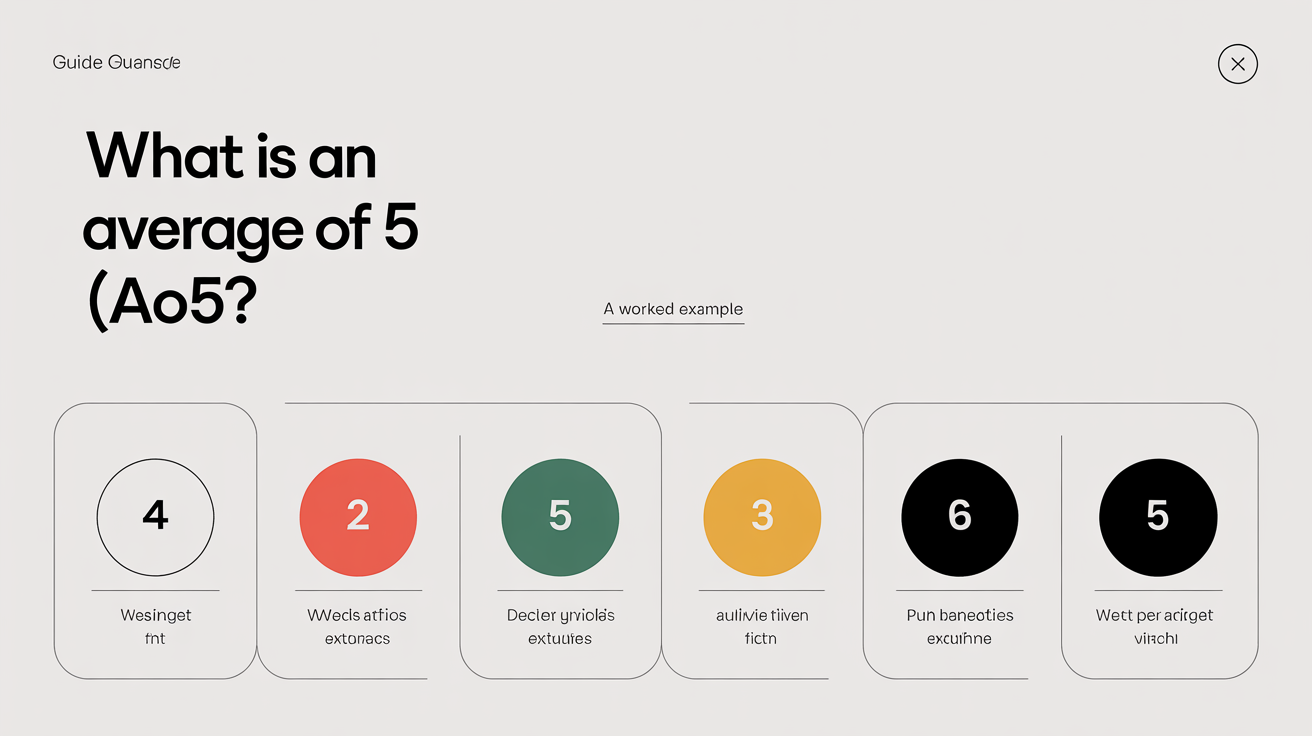
Here is a concrete set of five made-up times to show the math:
- 21.84 s
- 17.62 s
- 19.05 s
- 23.41 s,
dropped (slowest) - 16.30 s,
dropped (fastest)
After removing the fastest (16.30 s) and the slowest (23.41 s), three times remain: 21.84, 17.62, and 19.05.
Add them: 21.84 + 17.62 + 19.05 = 58.51
Divide by 3: 58.51 / 3 = 19.50 s
So this Ao5 is 19.50 seconds. Notice that the 16.30 s outlier did not bring the score down to something unrealistically low, and the 23.41 s rough solve did not drag it up. The number tells you something genuinely representative about those five attempts.
Most timer apps, like csTimer or Cstimer alternatives, calculate Ao5 automatically. Check out how to use a cube timer and read your times if you want to set one up and start tracking right away.
Why Cubers Chase Averages, Not Just Singles
A personal-best single is exciting. Dropping a 13-second solve when your average is 20 seconds is a real rush, and singles absolutely matter for certain goals. But averages are the truer benchmark for most people.
Here is why. A single is one roll of the dice. You might get an unusually short solution path, land a lucky case, or just string together five perfect move groups in a row. Singles are real achievements, but they are hard to replicate and hard to improve methodically.
An average, by contrast, rewards consistency. If your Ao5 drops from 22 seconds to 19 seconds over a few months, that means your look-ahead is better, your finger tricks are smoother, and your algorithm recognition is faster across many different scrambles, not just one charmed attempt. Competing against yourself using averages is far more motivating over the long run because the feedback is honest.
This is also why sub-20 (an Ao5 below 20 seconds) is a common milestone in beginner communities, and sub-10 is a major achievement marker at a higher level. Those milestones are stated in averages for a reason.
Building a structured practice session around Ao5s is straightforward: do sets of five, record your result, and notice trends. A realistic practice routine to lower your times walks through how to structure those sessions so each Ao5 is actually teaching you something rather than just filling a spreadsheet.
What About Ao12, Mo3, and Other Formats?
Once you understand Ao5, the other common formats follow the same logic.
Ao12 (Average of 12)
An Ao12 works exactly like an Ao5 but across twelve solves: remove the single best and the single worst, then average the remaining ten. Because it pulls from more data, an Ao12 smooths out variance even further. It is the metric many cubers use to track long-session consistency, and it appears on the WCA results page for some events. If your Ao12 is solid, it means you are not just landing good clusters of five, you can maintain your level across a full, extended session.
Mo3 (Mean of 3)
A mean of 3 is simpler: three solves, no drops, straight average. WCA uses Mo3 for certain big-cube events (5x5 onward) where solves are long and variability is expected. There is no trimming because with only three data points removing the best and worst would leave you with a single solve, which is not an average at all.
Single
A single is just one timed solve. Your personal-best single is the fastest solo attempt you have ever recorded. Singles and averages are tracked separately, you might have a 13.4 s single but a 19.5 s Ao5, and both numbers are meaningful in different ways.
| Format | Solves done | Solves dropped | Solves averaged |
|---|---|---|---|
| Single | 1 | 0 | 1 |
| Mo3 | 3 | 0 | 3 |
| Ao5 | 5 | 1 best + 1 worst | 3 |
| Ao12 | 12 | 1 best + 1 worst | 10 |
How DNFs Affect Your Average
A DNF (did not finish) is treated as an infinitely slow time, worse than any actual result. In an Ao5, a single DNF will be dropped as the worst result, so it does not ruin your average on its own. But the moment you have two or more DNFs in the same set, the entire Ao5 is recorded as DNF. This is the WCA rule, and most timer software follows it.
Practically, this means that learning to reliably finish every solve matters. It is not just about going fast, it is about never leaving a solve incomplete. One DNF per five attempts, and you are fine. Two DNFs in a row, and the whole set is toast.
For scrambling purposes, using a proper scramble generator helps ensure you are practicing on legal, consistent starting states so the scramble itself is never the reason for a DNF. See how to read and use a cube scrambler for a walkthrough on that.
Tips for Tracking and Improving Your Ao5
Getting your Ao5 down comes from two directions: reducing your worst solves (consistency) and pulling your middle solves faster (skill).
A few things that actually move the needle:
- Record every session. A timer app that logs your Ao5 history lets you spot when you plateau and when you break through.
- Review your slow solves. In a five-solve set, your dropped worst usually reveals a specific pattern, a recognition failure, a finger-trip on one algorithm, a cross solution you did not see in inspection. That one bad solve is data.
- Do not ignore the best either. If your dropped best was dramatically faster than the other four, ask why. Often it reveals a technique that worked, look-ahead you maintained, a shortcut on the cross, and replicating it intentionally is the path to a lower average.
- Aim for Ao12 targets too. Once your Ao5 is stable, start looking at your Ao12. If your Ao5 fluctuates wildly but your Ao12 is converging, you are actually improving even if individual sets feel inconsistent.
FAQ
What does Ao5 stand for?
Ao5 stands for "average of 5." It refers to the method of timing five consecutive solves, removing the best and worst, and averaging the remaining three. It is the standard format at WCA competitions and the most common way cubers measure their speed day-to-day.
Is my Ao5 always lower than my single?
Almost always, yes. Your personal-best single is the fastest you have ever solved in one attempt, which will typically be quicker than any average, including your best Ao5. That gap narrows as you get more consistent, but the single is almost always the lower number.
Can I get an official Ao5 outside of a competition?
Unofficial averages do not count for WCA records, but they are still meaningful for personal tracking. Timer apps like csTimer calculate Ao5 automatically and keep a full history, so you can compare unofficial sessions over time. Official results require a certified competition setting, proper scrambles, and judges, but the math is identical.
What happens if I get a DNF during an Ao5?
One DNF in an Ao5 is dropped as your worst result and the average is still valid, you just average the other three as normal. Two or more DNFs in the same set of five means the entire average is DNF, regardless of the other times.
What is a good Ao5 for a beginner?
There is no single benchmark, and progress varies a lot depending on how long you have been solving and how much you practice. Many beginners start around 3 to 5 minutes per solve. Getting under two minutes is an early win, under one minute is a solid milestone, and under 30 seconds usually means you have moved past the beginner method and picked up a more efficient approach. Focus on improving your own previous Ao5, not on comparing to others.