A Brief, Friendly History of the Rubik's Cube
From Erno Rubik's Budapest workshop to world championships: a plain-spoken look at how the cube was invented and why it never went away.
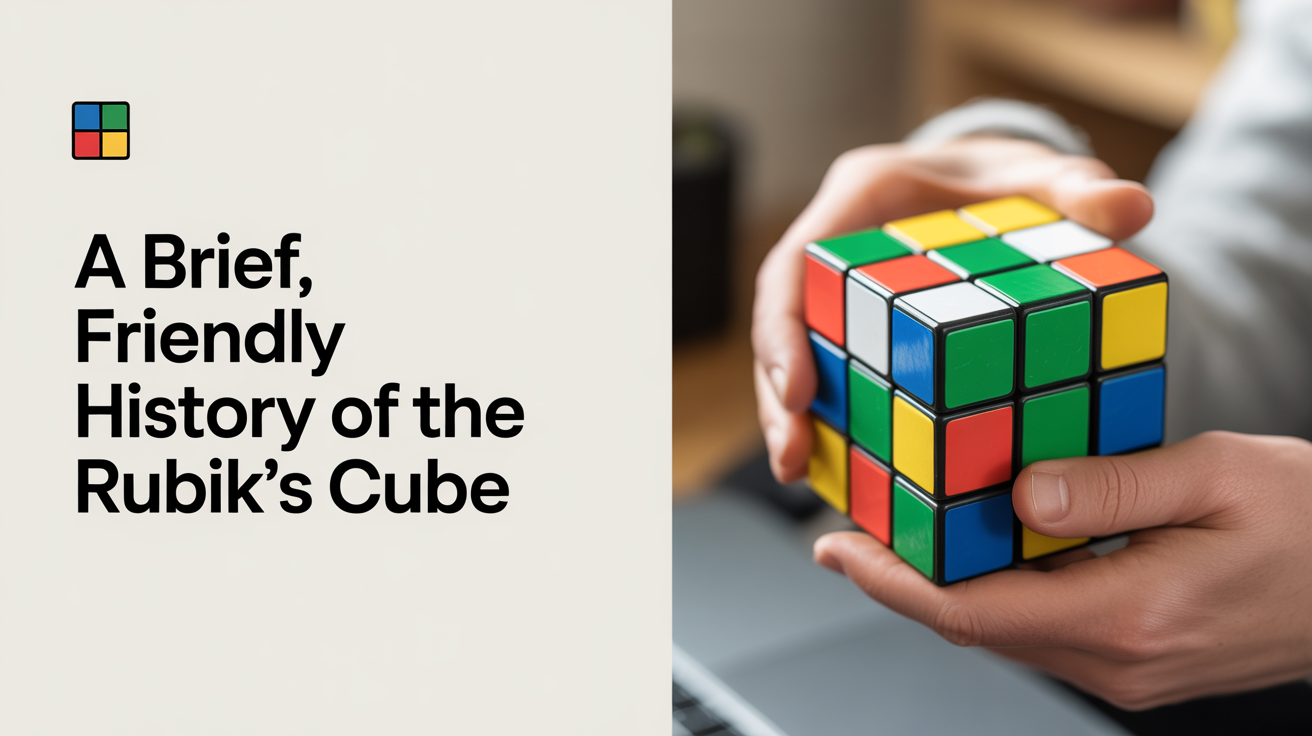
The Rubik's Cube is one of those objects that needs no introduction and yet somehow never stops surprising people. It sits on desks, appears in movies, and makes its way into the hands of curious six-year-olds and retired engineers alike. Before you pick one up and start working through how to solve a Rubik's Cube, it helps to know a little about where the thing came from and why it spread the way it did.
Erno Rubik and the Original Invention
The cube was invented in 1974 by Erno Rubik, a Hungarian architect and professor of interior design in Budapest. Rubik was teaching at the Budapest College of Applied Arts at the time, and he built the first prototype as a tool to help his students understand three-dimensional geometry.
His goal was not to create a puzzle. He wanted a physical model that could rotate in every direction without falling apart. He carved wooden blocks, wrapped them in paper, and worked through several mechanical designs before he arrived at the interlocking pieces that are still used today.
Once Rubik assembled the finished cube and scrambled it for the first time, he realized he could not put it back together. It took him about a month to solve his own creation. That moment, he later said, was when he understood he had made something genuinely interesting.
The Hungarian patent for the "Magic Cube" was filed in 1975, and small-scale production began within Hungary in 1977. For the first couple of years, the cube was sold mainly in toy shops in Budapest and was not especially well known outside the country.
The Toy Industry Discovers It
In 1979, a Hungarian mathematician named Tibor Laczi spotted the cube at a Budapest café and recognized its commercial potential. He brought it to the Nuremberg Toy Fair, where it caught the attention of Tom Kremer, a toy specialist based in London. Kremer brought the cube to Ideal Toy Corporation in the United States, and the company licensed it for international distribution.
Ideal renamed it the "Rubik's Cube" for the Western market, and by 1980 it was being sold across the United States, the United Kingdom, and much of Western Europe. The timing lined up well with the growth of puzzle culture and a broader public interest in games that rewarded patience and logic.
The cube became one of the fastest-selling toys in history during the early 1980s. Shops frequently ran out of stock, and a small industry of solution books emerged almost immediately. Hungarian mathematicians and computer scientists began publishing formal analyses of the puzzle, and newspaper columnists wrote about it regularly.
The First World Championship
By 1982, the Rubik's Cube had become popular enough that an organized competition made sense. The first World Rubik's Cube Championship was held in Budapest in June of that year. Nineteen competitors from thirteen countries took part.
The winner was Minh Thai, a Vietnamese-American teenager from Los Angeles, who solved the cube in 22.95 seconds. That time would seem slow by today's standards, but in 1982 it was remarkable. Competitors were solving the cube using paper solution guides memorized before the event, not the efficient algorithmic approaches that came later.
After that first championship, organized competition faded for a time. Interest in the cube dipped in the mid-to-late 1980s as other toy trends took hold, and for a while the cube became more of a cultural reference than an active hobby.
The Internet Revival and Speedcubing
The cube's second life began in the late 1990s and accelerated through the early 2000s. Online communities formed around cubing, solution methods were posted to forums, and people began sharing videos of fast solves. The internet made it easy for anyone to find a solution method and to connect with other people who were working on the same puzzle.
In 2004, the World Cube Association (WCA) was founded to bring formal structure back to competitive cubing. The WCA established standardized rules for competitions, including the use of a regulated scrambling method and a timer system that starts when the solver lifts their hands off the mat and stops when they place the cube back down.
Since the WCA was established, competitive cubing has grown steadily. Today the WCA recognizes dozens of events, covering not just the standard 3x3x3 cube but also larger puzzles, one-handed solving, blindfolded solving, and solving with feet. World records for the standard 3x3x3 have dropped dramatically as new solving methods and faster cube designs have developed.
To understand the mechanics behind all this speed, it helps to know how a Rubik's Cube works, including its faces, centers, and pieces.
A Timeline of Key Moments
- 1974 -- Erno Rubik builds the first prototype in Budapest as a teaching tool
- 1975 -- Hungarian patent filed under the name "Magic Cube"
- 1977 -- Limited production and sale within Hungary begins
- 1979 -- The cube is introduced to international toy industry representatives at Nuremberg
- 1980 -- International sales begin under the name "Rubik's Cube"; the toy spreads rapidly
- 1982 -- First World Rubik's Cube Championship held in Budapest
- Late 1990s -- Online communities revive interest; solution guides spread freely
- 2004 -- World Cube Association founded; organized competitive cubing resumes
- 2008 onward -- Sub-10-second solves become achievable for competitive solvers
- 2010s--present -- Cube design improves significantly; competition scene grows internationally
Why the Cube Still Matters
After more than four decades, the cube has not gone away. It is one of the best-selling puzzles of all time, and new solvers pick it up every year.
Part of what keeps it relevant is the learning curve. The cube looks impossible until you understand its structure, and then it becomes methodical. Most beginners are surprised to find that solving it is less about raw intelligence than about learning a small set of moves and applying them in sequence. If you are curious about that learning process, is the Rubik's Cube hard to learn? walks through what to expect when you start out.
The cube has also become a genuine sport. Competitions take place in cities across the world, and the WCA maintains rankings for solvers at every level, not just the world's fastest. There is room in competitive cubing for people who are working toward their first sub-60-second solve just as much as for elite competitors chasing world records.
Frequently Asked Questions
Who invented the Rubik's Cube? Erno Rubik, a Hungarian architect and professor, invented the cube in 1974. He built it as a teaching aid for his students in Budapest, not as a commercial product.
When was the Rubik's Cube made? The first physical prototype was built in 1974. The cube received a Hungarian patent in 1975, went on sale in Hungary in 1977, and became available internationally beginning in 1980 under the name "Rubik's Cube."
What are some notable Rubik's Cube facts for beginners? The standard 3x3x3 cube has over 43 quintillion possible positions, but any scrambled state can be solved in 20 moves or fewer. That number, called "God's number," was proven mathematically in 2010. The cube's internal mechanism uses a central core with each layer turning independently around it.
What is the World Cube Association? The World Cube Association is the governing body for competitive cubing worldwide, founded in 2004. It sets rules for competitions, verifies world records, and maintains rankings for solvers across dozens of puzzle events.
Do I need to know cube history to start solving? No. History is useful background, but learning to solve the cube is entirely about understanding its structure and practicing a method. The history just makes it more interesting to know what you are holding.