How Does a Rubik's Cube Work? Faces, Centers, and Pieces
Learn how a Rubik's Cube actually works — the fixed centers, 12 edges, 8 corners, and why understanding the parts makes solving click.
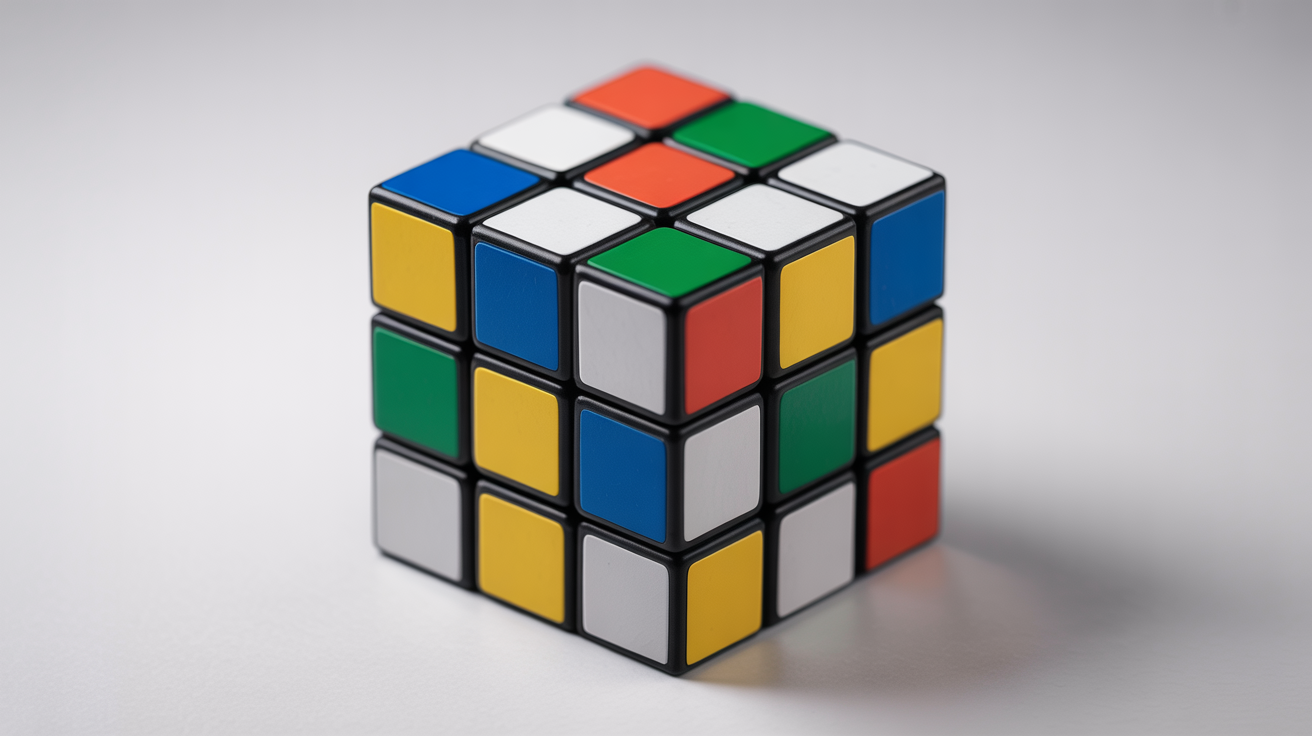
Pick up a scrambled cube and give it a few turns. Something is clearly moving, but it might not be obvious what is moving or why the puzzle behaves the way it does. Before you memorize a single algorithm, it pays to understand the machine in your hands. Once you see how the pieces fit together, everything about solving starts to make sense.
At a Glance
- A 3x3 cube has 26 outer pieces: 6 centers, 12 edges, 8 corners, plus an internal core that never moves on its own.
- Centers never move relative to each other, they define which color belongs on which face for the entire solve.
- Every edge and corner has both a position (which slot it sits in) and an orientation (which way its stickers face), and both have to match for a piece to count as solved.
- A single face turn moves 8 pieces at once (4 edges and 4 corners) while the center of that face stays fixed.
- The cube has roughly 43 quintillion legal arrangements, yet any solvable scramble can be solved in 20 moves or fewer.
- The puzzle's mechanics physically prevent certain shortcuts, like swapping just two pieces or flipping a single edge in isolation.
The Three Types of Pieces
A standard 3x3 cube has 26 outer pieces, and every one of them belongs to exactly one of three groups. No piece ever changes type; a corner is always a corner, an edge is always an edge. That constraint is what makes the puzzle solvable at all.
Centers
There are 6 center pieces, one on each face. Each center has a single colored sticker. Here is the key insight that surprises many beginners: centers never move relative to each other. They are anchored to an internal spindle at the core of the cube. When you turn a face, the eight surrounding pieces rotate around the center, but the center itself stays put.
Because of this, the centers define the final destination of every other piece. White center means the white face goes there. Blue center means the blue face lives there. You are not building toward some abstract goal; you are building around six fixed landmarks.
Edges
There are 12 edge pieces, each sitting between two centers. Every edge has two colored stickers. An edge has a position (which two centers it sits between) and an orientation (which sticker is facing which direction). Solving an edge means getting both right at the same time. Each edge piece can only ever visit the 12 slots that sit between two centers, and it can only show two of the six colors, whichever pair of centers it happens to be paired with by the manufacturer.
Corners
There are 8 corner pieces, one at each corner of the cube. Every corner has three colored stickers, one for each of the three faces it touches. Like edges, a corner has both a position and an orientation. A corner in the right spot but twisted still counts as unsolved. You will likely learn that lesson the hard way on your first attempt. A twisted corner is easy to miss at a glance because two of its three stickers can look approximately right, it is only the third face that gives it away.
Quick Reference Table
| Piece type | Count | Stickers per piece | Location |
|---|---|---|---|
| Center | 6 | 1 | Middle of each face |
| Edge | 12 | 2 | Between two centers |
| Corner | 8 | 3 | Where three faces meet |
| Total | 26 | — | — |
How Turning a Face Actually Works
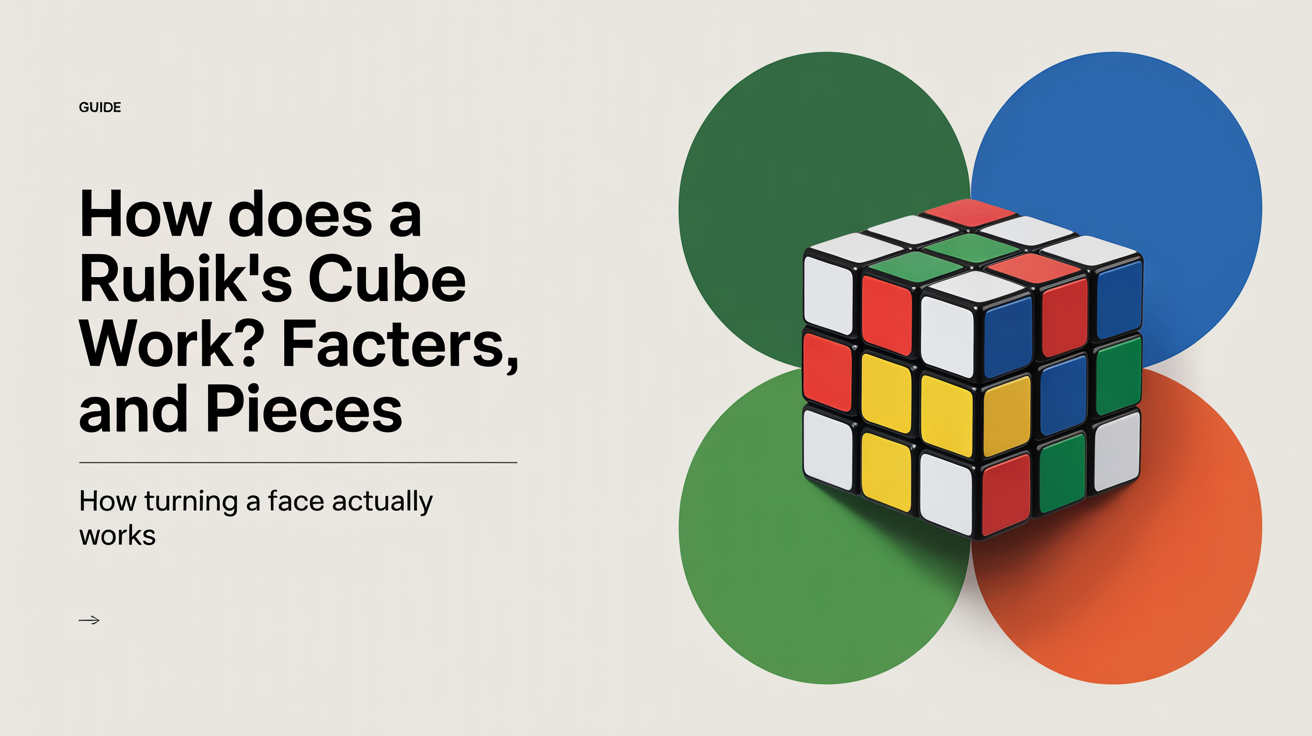
When you rotate a face 90 degrees, the center of that face stays exactly where it is. What moves is the ring of 8 pieces surrounding it: the 4 edges and 4 corners that touch that face. They cycle around the center in a loop.
This is worth sitting with for a moment. A single face turn affects 8 pieces simultaneously and does so in two ways: it changes their positions (they end up in different slots) and it changes their orientations (the stickers that were pointing up may now point sideways). Most of the work in solving is undoing those two kinds of changes without breaking what you have already fixed.
Because centers are fixed, each face has a permanent color identity. On the standard Western color scheme used in most tutorials:
- White is always opposite yellow
- Red is always opposite orange
- Blue is always opposite green
No matter how scrambled the cube gets, those relationships never change. If you see a center, you know exactly where the opposite face's center is.
Why the Cube Has So Many Possible States
The 26-piece structure is simple to describe, but it produces an enormous number of legal arrangements. Mathematicians studying the Rubik's Cube group have shown the cube has exactly 43,252,003,274,489,856,000 reachable positions, a number usually rounded to "43 quintillion." That total comes from multiplying the ways corners can be arranged and twisted by the ways edges can be arranged and flipped, then dividing out the combinations that face turns can never actually produce.
That last part matters: not every arrangement you could build by peeling off stickers and reassembling the cube by hand is reachable through legal turns. Face turns only ever produce even permutations of the pieces, which is the mathematical reason a single edge cannot flip alone and two pieces cannot simply swap places, described in more detail below.
Despite that huge number of possible scrambles, no legal position is ever more than 20 moves from solved. This upper bound, nicknamed "God's Number," was proven in 2010 by a team of researchers using a large-scale computer search, as documented in the Wikipedia article on optimal solutions for the Rubik's Cube. The practical takeaway for a beginner is reassuring: however scrambled your cube looks, it is never actually far from solved in a mathematical sense, even if it takes you far more than 20 moves to get there by hand.
| Fact | Value |
|---|---|
| Total legal positions | ~43,252,003,274,489,856,000 |
| Maximum moves needed to solve any position (God's Number) | 20 |
| Outer pieces | 26 (6 centers, 12 edges, 8 corners) |
| Pieces affected by one face turn | 8 (4 edges, 4 corners) |
Why Fixed Centers Matter for Solving
Every beginner's guide (including the one at /posts/how-to-solve-a-rubik-s-cube-a-beginner-s-guide) builds on this same foundation. When you place a white edge piece on the white face, you are not guessing where it belongs. The white center tells you. You are slotting pieces into a grid of fixed reference points.
This also explains a frustrating experience beginners often have: you get the top face looking solid white, but when you flip the cube over, the edges on the top layer have the wrong colors on their side stickers. The positions were right, the orientations were wrong. Both have to match the neighboring centers, not just the top center.
What Can and Cannot Happen
Because pieces can only move in the cycles that face turns create, there are things the cube physically cannot do:
- A single edge cannot flip in place without disrupting other pieces
- A single corner cannot twist without disrupting other pieces
- Two pieces cannot swap positions while everything else stays the same
These are not rules someone invented. They are mechanical facts, direct consequences of the group structure described above. Any valid scramble can be solved, but only within the set of arrangements these constraints allow. If you ever take a cube apart and reassemble it randomly, there is a high chance you create an impossible scramble, one with a single edge flipped or a single pair of pieces swapped, that no algorithm can fix, because no sequence of legal turns produces that state.
The Difference Between a Good Cube and a Stiff One
Understanding the mechanism also helps when shopping. The original puzzle uses a center-cap-and-screw design where the centers bolt directly to the internal core. Modern speed cubes redesign this mechanism with rounded piece shapes, adjustable tensions, and magnets that help pieces snap into alignment. These modifications are explicitly permitted under the World Cube Association's puzzle regulations, which allow internal refinements like lubrication, tensioning, and magnets as long as they improve stability rather than changing the basic concept of the puzzle. The pieces are the same three types in the same 26 positions; the engineering around them is just better.
If you are curious whether an upgrade is worth it, /posts/speed-cube-vs-original-rubik-s-cube-what-s-the-difference breaks down the differences in plain terms.
How Tension Affects the Pieces
On most modern cubes, each center screw can be tightened or loosened with a screwdriver or hex key, changing how firmly the layers grip during turns. A tighter cube locks up and resists moves; a looser cube can pop pieces out if you push too fast. Neither setting changes the types or counts of the pieces. The 6 centers, 12 edges, and 8 corners remain exactly the same regardless of how you tune the tension. What changes is how smoothly the ring of 8 pieces rotates around each center, not what those pieces are.
How Hard Is It to Actually Learn This?
Knowing the structure does not solve the cube for you, but it does shrink the mental mountain. Many people assume solving requires either genius or a photographic memory. It requires neither. You are learning to recognize piece types and move them to the right spots without disturbing pieces you have already placed. /posts/is-the-rubik-s-cube-hard-to-learn-what-to-expect covers realistic expectations for total beginners.
The short version: most people can solve their first cube in a few hours spread over a few days. Understanding the pieces first (what they are, what they can do, and what they cannot) tends to cut that time down, because you stop treating each move as a mystery and start seeing it as a predictable cycle of 8 pieces around a fixed center.
FAQ
How many total pieces does a 3x3 cube have?
A 3x3 has 26 outer pieces: 6 centers, 12 edges, and 8 corners. There is also an internal core (the spindle that the centers attach to), but that is not a playing piece. You never move the core; it is what everything else moves around.
Do centers ever move when you turn the cube?
Centers move with the whole cube when you rotate it in your hands, but they do not move relative to each other. No sequence of face turns can cause a center to swap places with another center. That is why they are the anchors for solving.
What is the difference between a piece's position and its orientation?
Position is which slot a piece occupies. For example, an edge might sit between the white and red centers, or between the white and blue centers. Orientation is the direction the stickers are facing within that slot. A solved piece must have the correct position and the correct orientation. One without the other means it is still wrong.
Can I swap just two pieces to solve the cube?
No. The mechanics of the puzzle make it impossible to swap exactly two pieces while leaving everything else unchanged. The minimum number of pieces that can cycle in a legal move is three. If your cube seems to need only a two-piece swap to be solved, either a piece was twisted incorrectly during a disassembly or the cube was reassembled in an impossible state.
Why do beginner methods solve the cube one layer at a time?
Layer-by-layer methods work with the structure of the cube rather than against it. You place pieces using the fixed centers as targets, starting with one face and working down. Each layer creates a stable base that you protect while working on the next. It is not the fastest approach, but it is the most intuitive one for a beginner because each step has a clear goal you can see.
How many possible combinations does a Rubik's Cube actually have?
About 43,252,003,274,489,856,000, usually rounded to 43 quintillion. That figure accounts for every legal arrangement of corners and edges reachable through face turns, factoring out the twists and swaps that are mechanically impossible. Despite that staggering number, the cube's 20-move maximum solving distance means no scramble is ever mathematically "far" from solved, even though it can certainly feel that way.