Beyond the 3x3: 2x2, 4x4, and the Pyraminx
A beginner's guide to popular twisty puzzles beyond the standard 3x3, covering the 2x2, 4x4, Pyraminx, Skewb, and Megaminx.
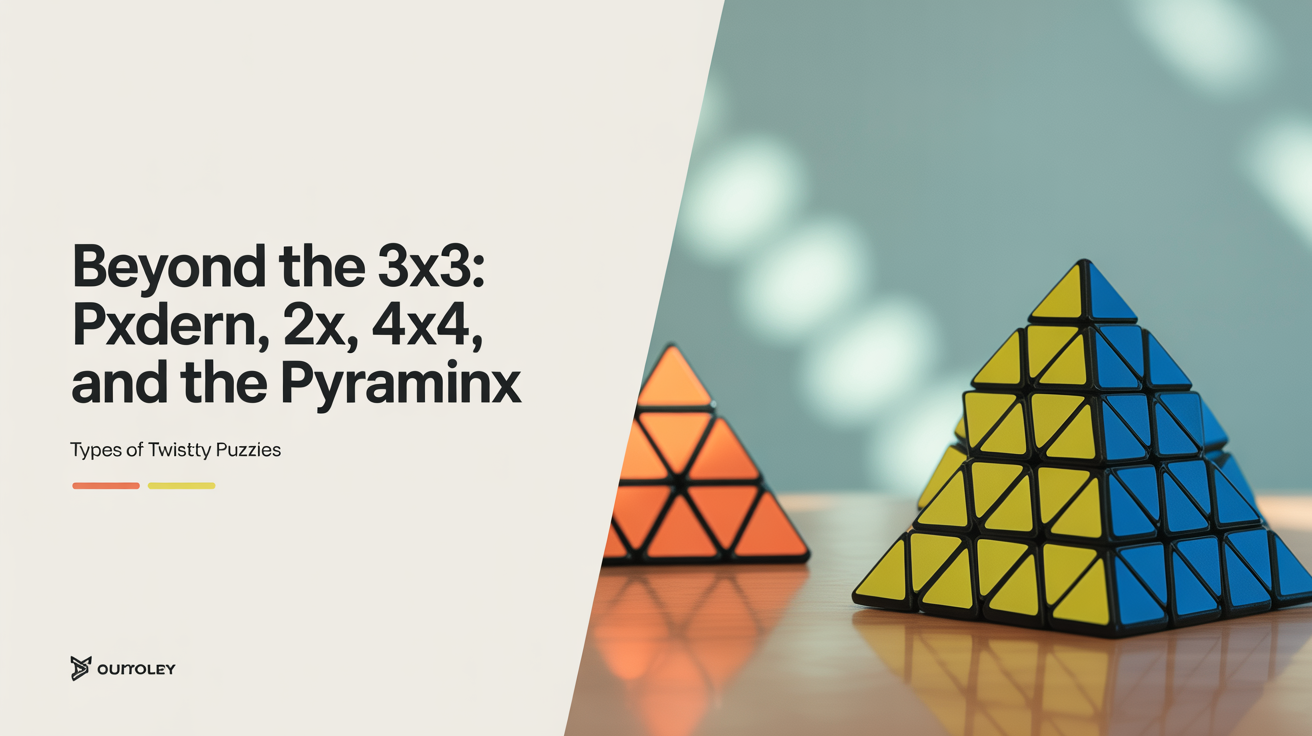
Once you can solve a 3x3, a natural question comes up: what else is out there? Twisty puzzles come in a surprising range of shapes and sizes, and many of them are beginner-friendly once you already know the basics. This guide walks through five puzzles you are likely to encounter, explains how each one works, and gives you a sense of where each fits on the difficulty scale.
The 2x2: Smaller, but Not Always Simpler
The 2x2 cube (sometimes called the Pocket Cube) has only eight corner pieces and no edges or centers. On the surface, that sounds like it should be easier than the 3x3. In many ways, it is: fewer pieces, fewer moves needed, and a good solve time is reachable in weeks rather than months.
The catch is that there are no center pieces to anchor your orientation. On a 3x3 you always know where a face belongs because the center never moves. On a 2x2, you have to track orientation differently, and some of the algorithms that fix corner twists will feel unfamiliar at first.
If you already know the 3x3 beginner method, you can solve the 2x2 using just the corners portion of that same approach. Most solvers pick it up in a single afternoon. It is a good second puzzle and doubles as a useful tool for drilling your corner recognition speed.
The 4x4: A Longer Solve With New Ideas
The 4x4 (often called the Rubik's Revenge) adds a layer of complexity that the 3x3 does not have. Because there are no fixed centers, you have to build the center pieces yourself before the solve can really begin. You also pair up the edge pieces before you start the main solve.
The method most beginners use is called the Reduction method: reduce the 4x4 to behave like a 3x3 by solving centers and pairing edges first, then apply what you already know from the 3x3.
The trickier part is a pair of situations called parity errors. These are positions that cannot happen on a 3x3 but can appear on a 4x4 because of the way the extra layers work. You need two short additional algorithms to handle them. They look alarming the first time, but once you know what they are, they are easy to recognize and fix.
Expect your solves to run about two to three times longer than your 3x3 times when you start out. If you enjoy methodical, step-by-step solving and want a genuinely longer puzzle to work through, the 4x4 is a natural step up.
| Puzzle | Pieces | Relative Difficulty | Extra Concepts Needed |
|---|---|---|---|
| 2x2 | 8 corners | Slightly easier than 3x3 | Orientation tracking without centers |
| 3x3 | 20 pieces | Baseline | Standard beginner method |
| 4x4 | 56 pieces | Moderate step up | Center building, edge pairing, parity |
| Pyraminx | 18 pieces | Very easy | Tip solving, simplified layer method |
| Skewb | 14 pieces | Moderate | Corner-first logic |
| Megaminx | 62 pieces | High (but methodical) | Extended F2L and OLL/PLL |
The Pyraminx: The Friendliest Introduction to Non-Cube Puzzles
The Pyraminx is a tetrahedron (a four-sided pyramid shape) with triangular faces. It looks unusual but is actually one of the easiest twisty puzzles to solve. The four tips at the corners each turn independently and can be fixed in one move each, so you solve those immediately and then focus on the rest.
Because the Pyraminx has fewer pieces and a simpler structure than the 3x3, the full solution only needs a handful of short algorithms. Many beginners solve it in under two minutes on their first genuine attempt after learning the method.
If you want to show someone a twisty puzzle that is not intimidating, the Pyraminx is a strong candidate. It is also a common WCA (World Cube Association) event, so there is a competitive community around it if you decide you enjoy it.
The Skewb: A Different Kind of Turn
The Skewb is a cube, but the cuts are diagonal rather than straight across. Each turn rotates a corner and the three faces around it, which means the puzzle moves in a fundamentally different way from a standard cube.
Solvers who try the Skewb after the 3x3 often find the turning mechanics disorienting at first because the patterns you built up for standard layer-by-layer methods do not transfer directly. The solve method is corner-first rather than layer-first.
That said, the Skewb has only 14 moveable pieces, and the number of possible algorithms you need is small. Once the logic clicks, a beginner can get to consistent solves in a few sessions. The Skewb is a useful puzzle for building spatial reasoning in a new direction.
The Megaminx: Big Commitment, Satisfying Payoff
The Megaminx is a dodecahedron (twelve pentagonal faces) and is one of the larger, more time-consuming puzzles in the beginner-friendly range. It looks intimidating, but the solve method is a direct extension of the 3x3 method: layer by layer, face by face, using algorithms you mostly already know from the 3x3 or can learn quickly.
The challenge is endurance rather than novelty. A beginner's first solve might take twenty minutes or more. There are also two parity-adjacent situations specific to the Megaminx's last layer, but these are well-documented and straightforward to handle once you know they exist.
If you have solid 3x3 fundamentals and want a puzzle that rewards patience and method over raw speed, the Megaminx is deeply satisfying to complete.
How to Choose Your Next Puzzle
The best next puzzle depends on what you find interesting about solving. A few patterns tend to hold:
- If you want a shorter, faster solve that tests your recognition, the 2x2 is a clean next step.
- If you enjoy the 3x3 method and want more of the same structure with added depth, the 4x4 builds on exactly that.
- If you want something approachable and different in shape, the Pyraminx is the most accessible non-cube puzzle.
- If you want to stretch your spatial thinking in a new direction, try the Skewb.
- If you want a big, rewarding project and already feel comfortable with the 3x3, the Megaminx is worth the time investment.
Whichever puzzle you pick, choosing a good hardware option matters. Magnetic versions of the 2x2, Pyraminx, and Skewb exist and are noticeably easier to control, which reduces misalignments and makes learning faster. You can read more about how that works in our guide to magnetic vs non-magnetic cubes. And when you do pick up a new puzzle, the same lubing principles that apply to a 3x3 generally transfer: a light, even application keeps the mechanism smooth.
Frequently Asked Questions
Is the 2x2 easier than the 3x3? Usually yes, but not always in the ways beginners expect. Fewer pieces means fewer steps, and you can use corner knowledge from the 3x3. The tricky part is that there are no fixed centers, which changes how you track orientation. Most people find the 2x2 easier overall, especially after they can solve the 3x3.
Can I solve a 4x4 if I already know the 3x3 beginner method? Yes. The Reduction method brings the 4x4 down to a 3x3-like state, so your existing knowledge applies for most of the solve. The only new elements are building centers, pairing edges, and handling two parity algorithms. These are learnable in a reasonable amount of time.
How hard is the Pyraminx for a complete beginner? The Pyraminx is one of the most accessible twisty puzzles available. A beginner who has never solved any puzzle can typically learn it faster than a 3x3. If you have already solved a 3x3, expect to pick up the Pyraminx method in a single sitting.
Do all these puzzles work the same way mechanically? No. Each puzzle has a different cutting geometry and a different internal mechanism. Some (like the 4x4) have floating centers; others (like the Skewb) rotate diagonally. The outward form of the puzzle usually signals how it turns, and you adapt your thinking to the specific geometry of each one.
Are these puzzles used in official competitions? Several of them are. The 2x2, 4x4, Pyraminx, Skewb, and Megaminx are all official WCA events. If you enjoy competing or comparing times, each of these puzzles has an active community and established records to look up for motivation.