The Layer-by-Layer Method: How Beginners Solve the Cube
The layer-by-layer method breaks a Rubik's Cube into six beginner-friendly stages. Learn what each stage does and how few algorithms you actually need.
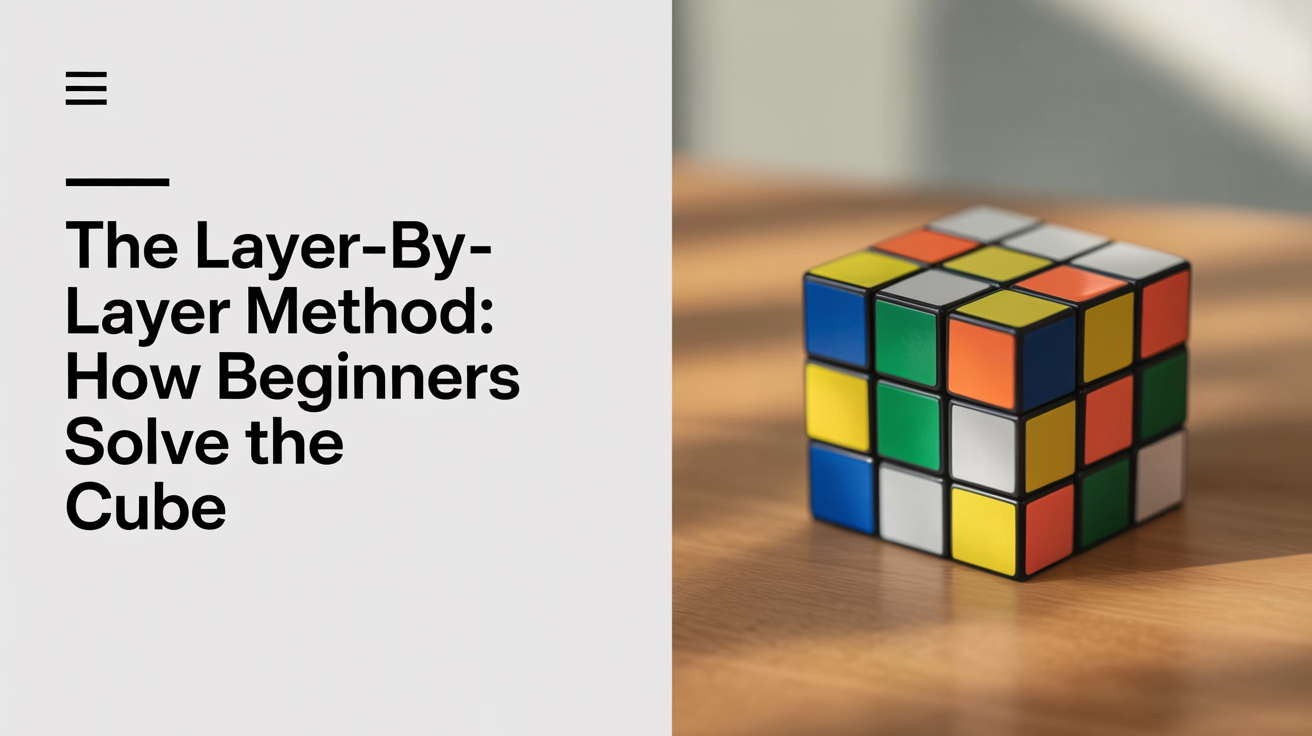
Most people who finally solve a Rubik's Cube for the first time do it the same way: one layer at a time. The layer-by-layer method (often called LBL) is the standard beginner approach for good reason. It breaks an overwhelming puzzle into six manageable stages, each building cleanly on the last. You do not need to memorize dozens of algorithms. A small handful gets most beginners to their first complete solve.
Here is how the whole method fits together.
Why Solve in Layers?
The 3x3 cube has 43 quintillion possible positions. That number sounds paralyzing, but the layer-by-layer method sidesteps the complexity by giving you a strict scope at every stage: you only work on a specific set of pieces, and the moves you use are chosen so they do not disturb what you have already finished.
This is the key idea. Once the first layer is done, the algorithms you use in stages three through six leave that layer completely untouched. You are always building forward without unbuilding backward.
There is one foundational fact worth understanding before you start: centers are fixed. The center piece on each face never moves relative to the other centers. The white center will always be opposite the yellow center; the red center will always be opposite the orange. This means each center tells you the final color of its face, and you use that information to orient every piece correctly throughout the solve.
The Six Stages at a Glance
Here is the full sequence, solved with white on the bottom and yellow on top:
- Build the white cross on the bottom, with each edge piece matching the center beside it
- Insert the four white corner pieces to complete the first layer
- Solve the four middle-layer edges (the ones with no white or yellow sticker)
- Make a yellow cross on the top face
- Orient the last layer so the entire top face is yellow
- Permute the last layer, first the corners then the edges, to finish
Each stage has its own guide on this site. The numbered list above is the reading order that makes the most sense for a first solve.
Stages 1 and 2: The First Layer
The White Cross
The first stage is building a white cross on the bottom face. Four edge pieces belong here. Each one has a white sticker and a second sticker that must align with the center of that edge's side. So the white-red edge piece goes between the white center and the red center, the white-blue edge goes between white and blue, and so on.
Many beginners solve this step entirely by intuition after a few attempts. There is no single algorithm you must learn; the moves are short, and most people figure them out by experimenting. The key check: flip the cube so white is on the bottom and look at the sides. Each arm of the cross should match its adjacent center color.
See the full walkthrough in Step 1: How to Solve the White Cross.
The White Corners
Once the cross is done, four white corner pieces still need to be placed. Each corner belongs in a specific slot based on the three colors on its stickers. A corner with white, red, and blue stickers goes into the corner between the white, red, and blue faces.
You use one core algorithm here, applied from a few different starting positions. The algorithm slots the corner in without affecting the cross you just built. After all four corners are placed, the entire bottom layer is solved: nine pieces, locked in, and you will not touch them again.
Step-by-step help is in Step 2: How to Solve the First Layer Corners.
Stage 3: The Middle Layer
Why the Middle Layer Comes Before the Top
At this point the bottom layer is done and the top layer (yellow side) is completely unsolved. That leaves four edge pieces in the middle layer, the horizontal belt around the cube's equator. These edges have two colors each, neither of which is white or yellow.
Solving the middle layer now, before touching yellow, matters because the algorithms for this stage only cycle pieces through the top and middle layers. The bottom layer stays safe.
You learn two algorithms here: one for inserting an edge to the left, one for inserting to the right. They are mirror images of each other. With a bit of practice, recognizing which one to use becomes fast.
The full guide is at Step 3: How to Solve the Middle Layer Edges.
Stages 4 and 5: Orienting the Last Layer
The Yellow Cross
After the middle layer, you look at the top face. Yellow pieces are scattered. Stage four makes a yellow cross on the top, just the top face, not worrying yet about whether the side colors match.
One algorithm handles this, applied one to three times depending on which yellow edge pieces are already pointing up. Beginners sometimes need a moment to recognize the starting shape (dot, L, or line), but once you know what to look for the recognition is instant.
Full Yellow Face
A yellow cross and a fully yellow top face are two different things. Stage five uses an algorithm to flip the yellow corner pieces (the ones with a yellow sticker on the side rather than the top) until all nine squares on the top face show yellow.
This algorithm may need to be run several times from different angles. There is a small trick to knowing when to stop and reposition, which the dedicated guides explain in detail.
These two stages together are what people usually mean by "orienting the last layer." You have not yet solved the cube; the side colors on the top row are still mixed up. But the yellow face is complete.
Stage 6: Permuting the Last Layer
Corner Positions
With the whole yellow face showing, the last task is to get every piece into its correct position. The corners come first. Right now each corner may be in the wrong spot even if it is oriented correctly. An algorithm cycles three of the four top corners around without moving the fourth, which acts as an anchor. Apply it until the corners are all in their home positions.
Edge Positions
The very last step cycles the four top edges into their final spots. Again, one anchor edge stays still while the other three rotate. Once all four edges land where they belong, every piece on the cube is solved.
At this point you can turn the cube and see six solid faces. That is a complete solve.
How Many Algorithms Do You Actually Need?
This is the question most beginners ask first, usually because they are worried the answer is "a lot."
The full layer-by-layer beginner method uses roughly seven to ten algorithms depending on how you count variations. Some of those algorithms appear in multiple stages, so the real memorization load is smaller than it looks. Many beginners get their first solve with five or six.
The moves are not long either. R U R' U' is four moves and one of the most common sequences in the method — it appears in several stages. Getting comfortable with that one sequence carries you a long way.
Speed is not the goal at this stage. Getting the solve to click conceptually, understanding why each stage works rather than just which buttons to press, is what turns a one-time success into a repeatable skill.
FAQ
How long does it take to learn the layer-by-layer method?
Most people solve the cube for the first time within a few hours of focused practice spread over several days. The early stages (white cross and first layer) often come together quickly. The last layer takes more repetition because the algorithms are less intuitive. A realistic timeline for a confident, repeatable solve is one to two weeks of casual practice.
Do I have to learn it in this exact order?
Yes, for the most part. Each stage is designed around the assumption that what came before is already solved. Trying to jump to the middle layer before finishing the first layer means the algorithms will break pieces you thought were done. The sequence is not arbitrary; it reflects which moves can coexist without interfering.
Can I use this method to eventually solve the cube faster?
The layer-by-layer beginner method is a foundation, not a ceiling. Many intermediate speedcubers use a refined version called CFOP (Cross, F2L, OLL, PLL), which builds directly on the same logic but combines stages and replaces the beginner algorithms with faster ones. Starting with LBL means the upgrade path is a natural extension of what you already know, not a restart.
What if I get the cube into a state that seems impossible to solve?
If you followed the stages correctly and something looks unsolvable, the most common explanation is that a piece was physically removed and reinserted in the wrong orientation. This can happen with a new or reassembled cube. A genuine scramble of a properly assembled cube is always solvable. If a corner piece looks twisted in place with no way to fix it, disassemble the cube and reassemble correctly; the algorithms cannot fix a physical assembly error.
Is the layer-by-layer method used in competitions?
Not at the top level. Competition solvers use systems with far more algorithms (CFOP, Roux, ZZ) that reduce solve times dramatically. But the layer-by-layer beginner method is still the entry point most competitors started with, and it remains the clearest way to actually understand how the puzzle works before moving to advanced systems.